Showing posts with label artist. Show all posts

Sunday, May 4, 2014

Salvador Dalí


Throughout my life it has in fact been very difficult for me to get used to the disconcerting and flabbergasting "normality" of the beings who surround me and who people the world. I always say to myself, "Nothing of what might happen ever happens!" I cannot understand why human beings should be so little individualized, why they should behave with such great collective uniformity. Take such a simple thing as amusing oneself by derailing trains! Think of the thousands of kilometres of railroad tracks that cover the earth, in Europe, America and Asia! And what a negligible percentage of those who have a passion for derailing trains ever put it into practice, as compared to the number who have a passion for traveling! When the train wrecker Marouchka was caught in Hungary this was regarded as a sensational and unique event.

I cannot understand why man should be capable of so little fantasy. I cannot understand why bus drivers should not have a desire once in a while to crash into a five-and-ten-cent store window and catch a few toys on the fly for their wives, and amuse the children who happened to be around.

I do not understand, I cannot understand why toilet manufacturers do not put concealed bombs in the flushing compartment of their products which would burst the moment certain politicians pulled the chain.

I cannot understand why bath-tubs are always made in approximately the same shape; why no one invents taxi-cabs more expensive than the others fitted inside with a device for making artificial rain which would oblige the passenger to wear his rain coat when he got in while the weather was fine and sunny outside.

I do not understand why, when I ask for a grilled lobster in a restaurant, I am never served a cooked telephone; I do not understand why champagne is always chilled and why on the other hand telephones, which are habitually so frightfully warm and disagreeably sticky to the touch, are not also put in silver buckets with crushed ice around them.

Telephone frappé, mint-colored telephone, aphrodisiac telephone, lobster-telephone, telephone sheathed in sable for the boudoirs of sirens with fingernails protected with ermine, Edgar Allan Poe telephones with a dead rat concealed within, Boecklin telephones installed inside a cypress tree (and with an allegory of death in inlayed silver on their backs), telephones on the leash which would walk about, screwed to the back of a living turtle . . . telephones . . . telephones . . . telephones . . .

Tuesday, December 31, 2013

Robert Smithson


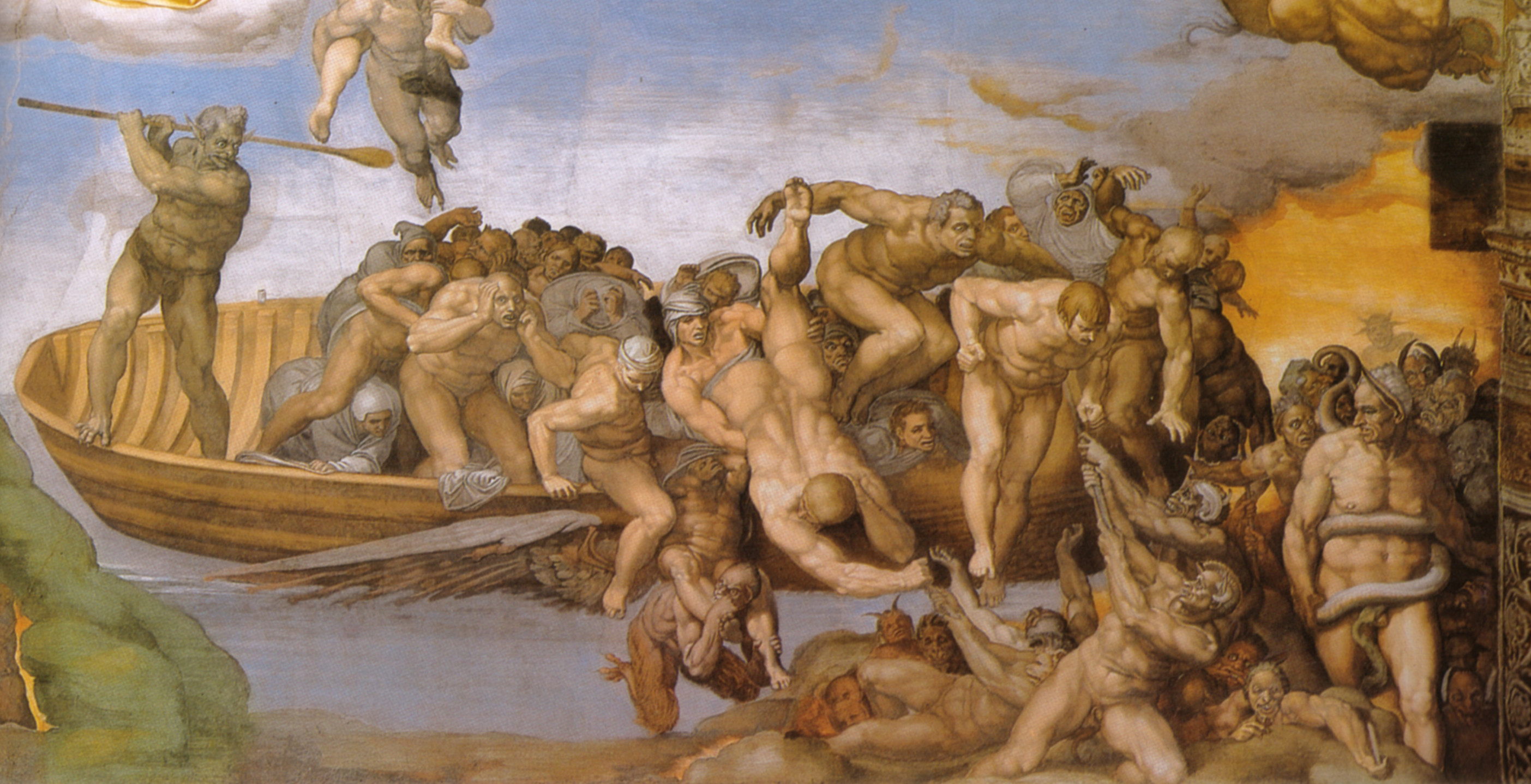
detail from Michelangelo's The Last Judgment [Wikipedia Commons]

from Robert Smithson's essay "What Really Spoils Michelangelo's Sculpture" in Robert Smithson: The Collected Writings:

Could it be that Michelangelo is nothing but a spoiled comedian, who spent long tedious hours working out intricate gruesome jokes, that really aren't too amusing? Are the grotesque horns on his Moses some kind of  a limpid jest? In this drowsy domain devoid of mysterious smiles, there is an undertone of listless laughter and torpid humor. A sluggish and immobile sense of time besieges the viewer of this decadent paganism. Not sloth, but the deterioration of sloth is felt, a decayed acedia that proclaims an inner grief through a profound sense of laziness. An idleness so acute that the body turns to lead and bile, an odious perfection that renders a titanic spectacle of waste. A sinking city of muscles submerges the mind in a somnolence so awful that no escape is possible. A Weltanschauung of criscrossing flesh forces the mind down into brute matter, every action is sunk in "melancholy." In the "Slough of Despond" the foul rot of nature engulfs the entire system of gods and demons. Never has stagnation been more total. Weariness turns into humorous levels of moribund grandeur. Every creature undergoes incessant punishment, because of the enormous weight of this ironclad universe. Bodies are swollen out of proportion, fattened like hogs, they fall downward toward fetid swamps. Heaven becomes a pigsty, a dirt enclosure completely airless, flooded with bilge water — with skies of dusty tar. Muscles like enormous worms, and polypi fade under a sickly ashen light. A slumbrous mood thick with idleness and despair faults every beautiful monster. Before us a psychic state of sterile power unfolds, grave, persistent in its gloom. The slacken bodies seem to stumble over each other, like titanic puppets. It has been said that acedia is caused by an imbalance of humors, Michelangelo seems to prove that speculation. The infirmity of his melancholia seems infinite and unending. Sloth is exalted into a major humor, and its permutations cover a cosmic scale. The stars are replaced with twisted mountains of flesh, there even evil is corrupted. It all looks so disgusting . . . so contemptible — a tidal wave of infinite carnality, a fleshy mess pouring from heaven (which is no place). Wan hope is triumphant in this quagmire of confounded passion. The Saturnine time of neoplatonic order infects his prisoners with an otium corporis that corrodes all spiritual joy and fortitude. Out of this comes the dismal comedy of enervation, a devastated sense of humor, a ruined joke, mock sacrifice, an obliteration of doom. Only nature is left with its maggots and filth — a snake chewing a penis. But this is not sad, it is hilarious. The fatality of humor begins in languor and ends in a farce.


Robert Smithson


Monday, September 2, 2013

2 September 2013


Marigolds

Concise (wooden)
         Orange.
Behind them, the garage door
         Pink
(Paint sold under a fatuous name:
"Old Rose"
      which brings a war to mind)

And the mind slides over the fence again
Orange against pink and green
Uncontrollable!

Returned of its own accord
It can explain nothing
Give no account

What good? What worth?

         Dying!

You have less than a second
         To live
To try to explain:
Say that light
         in particular wave-lengths
         or bundles wobbling at a given speed
Produces the experience
Orange against pink

Better than a sirloin steak?
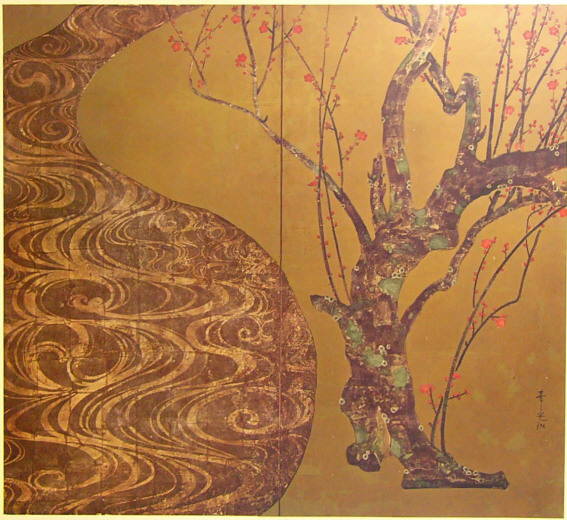
A screen by Korin?

The effect of this, taken internally
The effect
                     of beauty
                                         on the mind

There is no equivalent, least of all
These objects
Which ought to manifest
A surface disorientation, pitting
Or striae
Admitting some plausible interpretation

But the cost
Can't be expressed in numbers
Dodging between
            a vagrancy rap
            and the newest electrical brain-curette
Eating what the rich are bullied into giving
Or the poor willingly share
Depriving themselves

More expensive than ambergris
      Although the stink
               isn't as loud. (A few
Wise men have said,
       "Produced the same way . . .
       Vomited out by sick whales.")
Valuable for the same qualities
       Staying-power and penetration
I've squandered every crying dime.

Seattle 17-18:v:55

Ogata Kōrin

Monday, August 26, 2013

Norman Rosten

George Annand's drawing for the endpapers of Norman Rosten's The Big Road [George Annand, 1946]

from Norman Rosten's The Big Road:

Big road coming
Don’t you hear that sound
Bulldozers smashing
Through rock and ground

Start from Canada
Go way up past Tanan
Glory road building
Called the Alcan

Pick her up boys
Try her on for size
Boston to Omaha
As the crow flies

She’s a high-rolling baby
With the right of way
Not much to look at
But here to stay

Call her the oil-can highway
Call her sweat and mud highway
Call her sweet-Jesus highway
That’s the one . . .


Wheel turning, not upon stone but saga,
Endlessly between the dead and the living.
Rider, you have begun long ago.

From coasts which knew Ulysses’ oars,
Compulsion of commerce, stirring of migrations,
And how man did move upon the surface of his world.

From out of the groin of Asia, the savage tribes
Crossing an isthmus, spill down the hemisphere,
Their paths enlarged and leading to many wonders.

Like Janus with his faces, be multiple,
O rider as you journey between cities
Hear the thunder of wheels on the hard Appian,

Lanes connecting, the myth of miles,
Can you hear the hooves of the caravan:
Listen to eras sing beneath your tires!

Navel of earth
                       feed back
                                        origin and order . . .


           From a given point on a straight line
           to erect a perpendicular
                                                Mathematics
To plot outside of the natural contour,
Raised from the ground.
                                    From a point outside
                    a straight line to drop a perpendicular
                    to the line
                                    Given the earth’s surface,
Problem to secure a right angle . . .
                                                       To survey.

Groma, instrument to align a distant point.
Ferramentum, the iron part which supports;
Stellata, the square frame resting upon it,
Carrying the names of the four directions;
Four lines from these points suspended,
Becoming plumb lines, the true vertical of sight;
From its center a fifth line touching the ground,
Vertex of angle laid upon the land.

           Having balanced the ferramentum,
           you drop from the center a perpendicular
           to the point of the stone.” (NIPSUS)


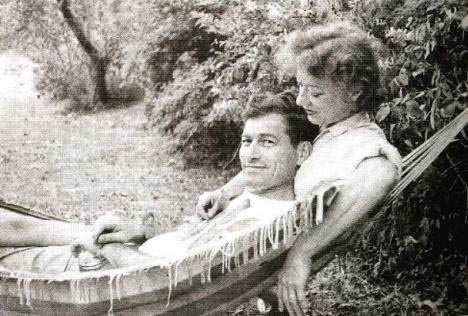
Norman Rosten, Hedda Rosten [Cursum Perficio]

Monday, July 29, 2013

29 July 2013

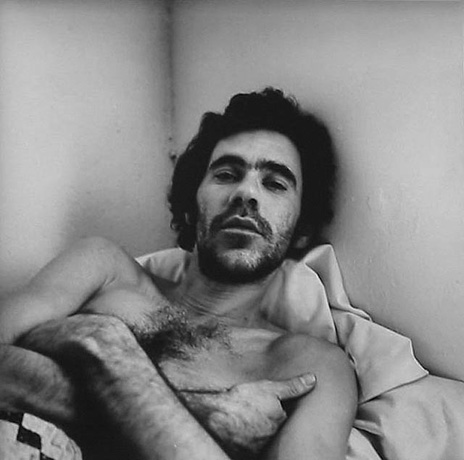
Stephen Kuusisto [Steve Sartori]


Letter to Borges in His Parlor

What will become of you
With your Anglican heart and old furniture?
Are you waiting for insects at the geraniums?
What is there to love anymore, my friend?

Some days I, too, don’t feel like going out.
Secluded with my gramophone
I play “Flores purisimas,” zarzuela,
Caruso — over and over.

Once, years ago, I got lost in the vast cemetery of Milan.
I had my dog; I was taking roses to Toscanini’s tomb.
It was an ordinary day,
Men were digging graves.

Confounded in the ballyhoo Italien,
The tombs carved like sailing ships,
I talked to perfect strangers:
Women alone with grief,
Men walking “on doctor’s orders.”

It is good, Borges, to have a mission, don’t you agree?


Letter to Borges from New York City

You can get lost between heartbeats and strangers will know.

I climbed out of a carriage at Central Park and I heard a man speaking Russian to his horse.

I was lost just then and believed the cabman’s horse
Knew full well my predicament.

I suspected the horse was staring into the late autumn sun.

I heard two men arguing about how to carry a sheet of glass when the wind is fierce.

We are never far from the circus or the general belief in alchemy.

On Fifth Avenue, Paracelsus still makes his living selling thimbles and miniature Greek flags.


Letter to Borges from Syracuse

Down where the great tenor must have felt it, under my left-side low rib
There was a green fruit, a pear of the mind, moonlit, cold and wet.

I felt it early, bending to the paper, just a curve
From the torso, a twist

That was not me, do you understand? I called to a bird
In the catalpa, called it bird-wise, soft

But to no effect. I was rich,
Alive, with nowhere to go, fruit from a dream

Hanging where my lungs and diaphragm met.
I wanted to stay there always,

Do you understand? My blindness was just a nuisance.
The pear, an unworldly thing.

Swayed, understand, and grew on nothing.

Rosamond Purcell [The Compass Rose]

Monday, June 24, 2013

24 June 2013

William Gass [Philip Guston]

from William Gass’s “Auguste Rodin” from A Temple of Texts:

Rodin’s surfaces are there to suggest a reality that can only be inferred, just as fingers or a face, by gesture or expression, disclose a consciousness that would otherwise be indiscernible. Sculptures are things: they start as stuff, stuff taken from stuff like rock or clay, and they stay stuff until the artist gives them a determinate form so that, through that form, they may have life. The poet’s problem is precisely the opposite. Language is our most important sign of elevated awareness, but language has weak presence. Though often on paper, it possesses no weight. A poem is like a ghost seeking substantiality, a soul in search of a body more appealing than the bare bones mere verses rattle. . . . the poet must also be a maker, as the Greeks maintained, and, like the sculptor, like every other artist, should aim at adding real beings to the world, beings fully realized, not just things like tools and haberdashery that nature has neglected to provide, or memos and laws that society produces in abundance, but Ding an sich, as humans often fail to be, things in themselves. . . .

Rilke’s animism is poetical, of course, but is also, in its way, religious, for it requires respect for all things equal to the respect we tend to show now for only a few, since we prize so little even in the things we prize. It gives value, as Rodin did, to every part of our anatomy, to each muscle movement — stretch, twitch, and fidget; our physical features — a silk soft earlobe, tawny limb, or crooked finger; or facial expressions — grimace, smile, or howl; as well as the very clay we come from (at least in his workshop) — wood block, slab, and plaster pot. Moreover, it endows even the accidental encounter of different parts — my hand on your shoulder — with its own dignity as a legitimate state of affairs. . . .

the surfaces of Rodin’s work, which his studio light makes lively, implicitly rely upon a philosophical principle of great age and respectability . . . Since the effect in question is one of animation, it may seem odd that the principle involved is that of inertia. A body at rest will remain at rest — a body in motion will remain in motion — unless something else hectors or hinders it. When that interference occurs, the stone or the ball or the dog at the door will resist; it will attempt to restore the status quo, strive to save its situation, maintain its equilibrium, preserve its life. Spinoza called the tendency to stay the same the object’s conatus. It is popularly thought of as the principle of self-preservation. All things would be self-sufficient, as windowless as Leibniz’s monads, if they could. The condition of the fetus, which is automatically fed, protected from every outside shock, surrounded by an embalming ocean, growing as it has been programmed to grow, is ideal. We are pushed out into the world; we are forced by circumstances both inside us (hunger and thirst) and outside (sensation and harm) to cope, and, as Freud argued, we are repeatedly compelled to reduce the unsettling demands of our desires to zero.

A limp that tells the world we are compensating for an injury becomes a habit hard to break even when its cause has healed and there is no longer any “reason” for it. Except that the limp wishes to remain. Our stutter wants to stay. Our fall from a ladder would be forever like a cast-out angel if we didn’t fetch up in a lake of fire or at least on a floor. The fire, moreover, eats its way through every fuel it’s offered only because it is eager to stay burning like that bright gem of quotation fame. As the naked models move about Rodin’s studio, he observes the participating parts of their bodies until he can catch, in the middle of an action, the very will of the gesture, its own integrity and wholeness. . . .

the elements of a work of art must form a community which allows each element its own validity while pursuing the interest of the whole. A word, if it could have had a choice, must feel it would have chosen just the companions it has been given, so that when it glows with satisfaction, it also makes its line shine.

Moreover, the unity of a sculptural fragment, when imagined alongside a correspondingly severed limb, insists upon its own superiority, for it can flourish quite apart from any body, whereas both amputation and amputee are damaged possibly beyond repair.


Buddha

As if he listened. Silence. Depth.
And we hold back our breath. Yet nothing yet.
And he is star. And other great stars ring him.,
though we cannot see that far.

O he is fat. Do we suppose
he’ll see us? He has need of that?
Sink in any supplicating pose before him,
he’ll sit deep and idle as a cat.

For that which lures us to his feet
has circled in him now a million years.
He has forgotten all we must endure,
encloses all we would escape.

Saturday, June 22, 2013

Joe Brainard

Joe Brainard [htmlgiant]

from The Collected Writings of Joe Brainard:

The People

                       And the mountains shall bring peace to the people.
                                                                          — Psalm 72:3

Today I will uphold others with my prayers. Tomorrow I will let my light shine. And day after tomorrow I will help build up the Kingdom of God. I never plan more than two days ahead. For in all actuality, tomorrow is another day. I am a painter. And what I want to do most of all is to tell you all about the people. I love them. First I'll tell you a story about Mary Morey, and now my story's begun, I'll tell you another, about my brother. (“I just thought I'd add another crime to the family record by butchering my brother Jim with an axe in his bath!”) And now my story's done. However, I've another one.

Once upon a time ago (many years) a little cock-sparrow sat on a tree looking as happy as could be. Why not? A  boy came (John David Anthony) along with his wee bow and arrow, and said he, “I shall shoot dead that little cock-sparrow!” “His beautiful body will make me a nice little stew, and his giblets will make me a little pie too.” But, “No, no, no!” said the sparrow, “I won't make a stew.” And with a flap flap of the wings he flew flew flew. (Like fast in order to make Eggland on time ((six)) for a surprise ginger ale party for Wee Willie Winkie Pinkie upstairs and downstairs in his pink nightgown.) However, he didn't make it. On his way he met this little man, and he had a little gun, and his bullets were made of lead, lead, lead. And he shot the little cock-sparrow through the middle of his wig, and knocked it right off his head, head, head. It was immediate death. However, reports have it that the ginger ale went flat and Wee Willie Winkie Pinkie was in a terribly bad mood. (Depressed.)

You know, we are all living in troubled times, when peace seems almost impossible. One bright spot, however, is the growing awareness among Christians each and everywhere that we all belong to one big family — the family of Jesus Christ. I would like to close with this thought for tomorrow: “The best way of knowing God is to frequent the company of his friends.” (Compliments of Rita F. Snowden.)

However, I've more to say. I had a little nut tree, and nothing would it bear, but a purple purple apple and a silver golden pear. It was really frustrating. I’ve always been terribly fond of nuts. Ginger snaps. And butter cakes are good. However, I’ve always felt terribly sorry for brown chocolate trying to be unusual.

You know, what I really like about people is how good they are to look at. And how, with just a something or another you can love someone far far to easily. And sometimes those things just happen. Once one misty moisty morning, when cloudy was the weather, I chanced to meet this old man, dressed up all in leather. He began to compliment, and I began to grin. How do you do?, and How do you do?, and How do you do again?

I’m fine. But you know, some people don’t like things. However, I do. I shall never forget from my seat in the Royal Albert Hall (London, England) artist and instrument seemed fused into one. Yehudi Menuhin stood before me that night playing Mendelssohn’s Concerto in E Minor. It was really good! Existence becomes true real life when it merges with the lives of others. (People.) As Bernard Shaw wrote once something to the effect that the very worst of sins is not to hate them but to be indifferent to them. As I do remember correctly he described such indifference as “the essence of inhumanity.” Which is a rock if I ever saw one. For, for every evil under the sun, there is a remedy, or there is none. If there be one, find it, if there be none, mind it. But most important of all: Love the people, I do.

P.S. Higher than a house, higher than a tree, oh, whatever ever can that possibly be? (Star.) Which reminds me of my recent short trip to Dalmatia. During my recent short trip to Dalmatia I enjoyed walking along the coast of the Adriatic Sea. It was a simply splendid evening. The moon sailed in the sky, and its light dispersed in thousands of pearls on the calm black surface of the sea. I’ve always loved black. And pearls excite me. However, I found the Adriatic to be rather large.

Sunday, April 28, 2013

28 apr 2013

La BlanchisseuseHenri de Toulouse-Lautrec [Wikipedia]

La Blanchisseuse

Though she knows
smoothing cloth
how to smooth a cloth
on a flat surface

how to scrub a stain
how to warm the irons
to iron, bite off thread
tie a knot, restitch
a raveled seam

how to cut from yardage
the idea of a sleeve
to fashion a shirt
for someone else

though washing
sewing, she’s looking off
beyond a world
of fingers on cloth
of lye, of steam

undermining
the weave of labor
the dour distraction
of indoors.

Noah Eli Gordon [rob mclennan's blog]


Are You Ashamed of the Indifference with Which You 
Greet the News of the Death of Pinochet

Lyrically, country & western music is a combination of the trials
& successes of everyday life. Gilbert & Sullivan are a combination,
but the satirizing of society of the Victorian period hardly seems relevant
to our present concern. Pitched lower than a trumpet & higher than a tuba,

the French horn is not a combination. What, exactly, is fearful symmetry?
The two largest individual optical telescopes on Earth sitting atop Mauna Kea?
Thousands of small photographs combining to form the image of a wolf?
An object held in one’s hand having potential energy, a combination

turning motion, position, & mass into a balanced definition? I’ve never held
a French horn, but think I would enjoy the equilibrium of its potential heft?

The Year of the Rooster [excerpt]

. . .

(––––––––––––––––If you ask
(––––––––––––––––when Rooster’s talking
(––––––––––––––––your listening
(––––––––––––––––isn’t apt enough
(––––––––––––––––to hear it

. . .

Two seasons later
it’s the shell of a beetle
baking in the sun

brittle in the sun

I watch over you because you need me

Forgive the systematic contortion
of removals, from a coarseness comes
a fiery magnetism, from an anxious dream
an encroaching boredom

After four hours
dawdling with the wardrobe, I leave furiously
a city & its wintering sheen, remove
the hens, then those for whom
the remaining space is responsible

. . .

          It’s my fault
rummaging through dead-ends of daily experience
                 capitalizes on gratuitous snowfall
                         to sculpt some metonymic purity

Saturday, March 23, 2013

Henri Michaux

haruspicate: prophesy by reading animal entrails


no title, 1961 [pic courtesy of Galerie Van de Loo Projekte]

from Untitled Passages by Henri Michaux, ed. Catherine de Zegher, 2000:

the tree without end, the tree of life that is a source, that is, dotted with words and images and propounding riddles, the flow that, without interruption, even for one single second, passes through man [sic] from the very first moment of his [sic] life right up to the last, stream of sandglass, that only stops when life stops . . .

Is a statement really necessary? Isn’t it obvious that I paint so as to leave words behind, to put an end to the irritating question of how and why? Could it really be that I draw because I see so clearly this thing or that thing? Not at all. Quite the contrary. I do it to be perplexed again. And I am delighted if there are traps. I look for surprises. To know always would bore me. It would upset me. Must I at least be aware of what’s been going on? Not even. . . .

When it comes to countries, the more one distrusts them the better. . . .

A man and his face, it’s a little as if they were constantly devouring each other. . . .

I don’t think much about influences. You enjoy listening to people’s voices in the street, but they don’t solve your problem for you. When something is good it distracts you from your problem. . . .

No longer to imitate, but to signify nature. By strokes darts, dashes.
Ascesis of the immediate, of the lightning bolt. . . .

Like nature, the Chinese language does not draw any conclusion of its own, but lets itself be read . . .
Characters open onto several directions at once.
Point of pure equilibrium . . .
Calligraphy in its role as mediator between communion and abeyance . . .
Calligraphy around which — quite simply — one might abide as next to a tree, or a rock, or a source. . . .

Vibrant certainty
its touch so fine, making a sign
peak, abyss on the same line. . . .

Henri Michaux [pic courtesy of Isola di Rifiuti]

In a black mood [after his wife’s death of burns] I start, having grabbed one, to cover it with a few dark colors and sullenly to squirt water onto it at random, not in order to do anything in particular, and certainly not a painting. I have nothing to do, I have only to undo. To undo the world of confused, conflicting things in which I am plunged. . . . 


They were gestures, interior gestures, the ones with which we don’t have limbs but desires for limbs, stretching, impulsive movements and all this with living ligaments that are never thick, never big with flesh nor enclosed in skin . . . What an experience it will be when the time is ripe at last and, having got into the habit of thinking in signs, we are able to exchange secrets with a few natural strokes like a handful of twigs.