Wednesday, January 16, 2013

16 enero 2013

Parkinsonia praecox, Sonoran palo verde, brea, [pic courtesy of the Glendale Public Library]

Today we transplanted four breas into our garden, one big, one middle, two small.


the big brea, north border, east of house

Today

on the bristlemallow
a splotch of pink
though bristlemallow flowers salmon-mellow

petal-scattering rose

for the lake Veronica favors a balanced biome
beyond tadpole hatches
lapwings & kiskadees eating them

start out with iris throws

drum of hammers on the half-tiled roof
whine of electric saw
drone of diesel-powered moto

cadence of men speaking castellano

Sewing circle happens on Wednesday afternoons here. Ten stitchers & felters today. Buoyed by confidence gained earlier this month by crocheting a cotton dishcloth, I've begun crocheting a mouse from eggplant-color wool yarn.

Tuesday, January 15, 2013

15 enero 2013

Zucchini Bun

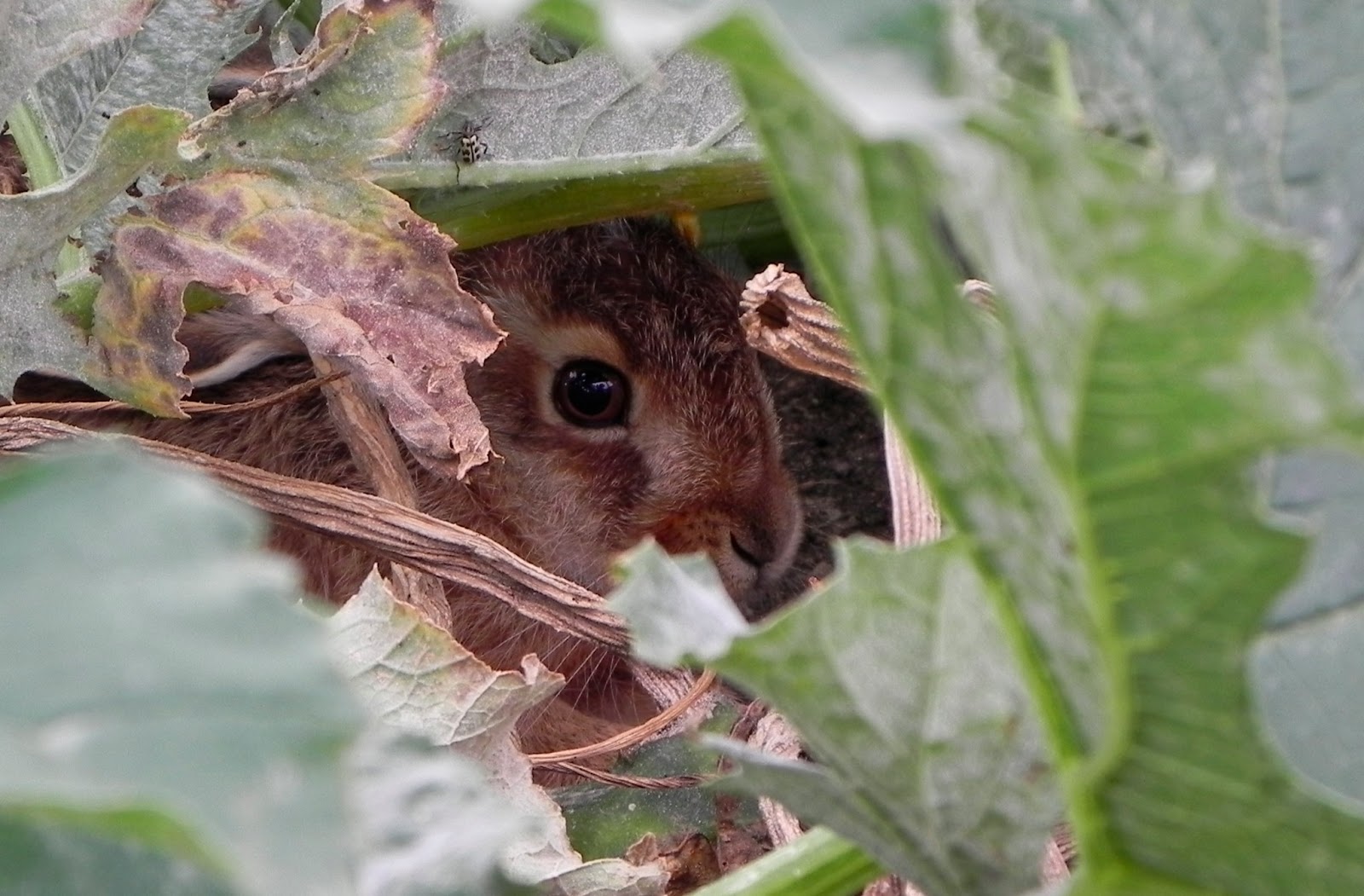
now the small rabbit lives in my garden
nestles among zucchini
as long as I remember to move slowly
it lets me be there too

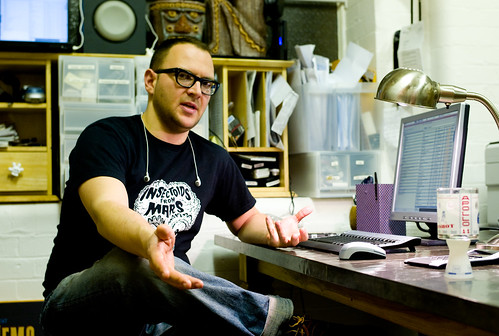
Cory Doctorow's RIP Aaron Swartz

Cory Doctorow [pic by Joi Ito, courtesy of Creative Commons Wiki]

If you haven't read Little Brother, read it now (free ebook download) & then, read the sequel, Homeland, soon to be released.


this morning I wrote a found poem . . .

I Asked Myself

what items
I wanted
in my culture

created

newly and justly
to contain
my needs

the world
isn’t a text
to be deciphered

it is a new creation

a cloud
enters you
to begin in

A found poem is something a poet finds in someone else's writing.
The poet makes what she finds into a poem.
Poems are to be found everywhere.
Find your own.


Leroy’s Brain

It’s September in the codex — a gold ink month. Snakebite healing
he wears a sling, but no one believes he’s been bitten. A fall,
a sprain . . . Marie believes him; she sees lots of snakes around . . .

But here’s the funny thing. The shock of the bite — and the trauma
of Ruby’s death — make Leroy tell the truth. Though it sounds
more than ever like lies.

I talk to her, he says, I see her in heaven. He hasn’t had this
experience, has he? What do you think? The brain
exists to soothe you, it tells you how to see the right thing.
The brain is the big trick: you tell it what your codex is. So you can

see that. I talk to her, he says. I see her in the afterlife. Sure you do.
And, if you can describe a vision, maybe that’s having it too.
I talk to her, I see her in the afterlife. Fuck it, I do.

Muslin

The girls come at dusk wearing red paint

on their lips and cheeks, shouting they are Satanists; one
has red paste jewels in her hair. Everyone’s such a hack ritualist.
I the poet dream of the girls and wake up shaking in Paris.
They say they are driven by their fathers to be sexual
Satanists; they carry the AIDS virus. They say they have to

be like this. Does anyone have to do anything? You can just die . . .

I have to do what Daddy says. He makes me real.

Fill Out Questionnaire for Good

I couldn’t find you in my metrics but I couldn’t change it
could I? I couldn’t change my language; I couldn’t change
my father or his name. I couldn’t rip the rubies out of my
hair; and when I went to her shack to scream whore at her

I knew I was that word. But there is no whore. My feelings
of discomfort are an argument for eternity — you don’t
know what I mean? But you aren’t here. I mean my feelings
may be transitory but are absolute at the moment, I have
stayed so long in moments, so deeply in them that
I came close to being god. Though I felt like someone who

had fallen from unconditional grace: it would love you
no matter what, but you might leave it out of curiosity —
isn’t this way of being tiresome? If I went to hell would I

care, would it really be different from heaven? No
I don’t know what I’m saying; these aren’t my answers.
I don’t care about being alive — women don’t care about
that, they just care about you. Oh you. Only you.

nearly every day now, small rains
I'm not eating as much today
the feeling that I might be starving has passed

Monday, January 14, 2013

14 enero 2013

It's difficult not to glance at the world news, but it's all bad. The hounding of Aaron Swartz. The flouting & touting of idiots from the US, France, MIT. Idiots from government, religion, finance, medicine, education, sports.

Therefore nature, art, sensation, emotion. Chocolate. Links from friends.

“The talent of composition is very dangerous, — the striking out the heart of life at a blow, as the Indian takes off a scalp” [Thoreau]

Remy de Gourmont [pic courtesy of le tiers livre]

from Ezra Pound’s “De Gourmont: A Distinction” in The Little Review, Vol. V, Feb-Mar, 1919:

De Gourmont was an artist of the nude. He was an intelligence almost more than an artist . . . He is a poet, more by possessing a certain quality of mind than by virtue of having written fine poems . . .

He was intensely aware of the differences of emotional timbre; and as a man’s message is precisely his façon de voir [way of seeing], modality of apperception, this particular awareness was his “message.” . . .

He does not grant the duality of body and soul. . . . “My words are the unspoken words of my body.” . . .

sex is not a monstrosity . . . Sex, in so far as it is not a purely physiological reproductive mechanism lies in the domain of aesthetics, the junction of tactile and magnetic senses; as some people have accurate ears both for rhythm and for pitch, and as some are tone deaf, some impervious to rhythmic subtlety and variety, so in this other field of the senses some desire the trivial, some the processional, the stately, the master-work. . . .

De Gourmont is interested in hardly anything save emotions, and the ideas that will go into them, or take life in emotional application. . . .

La virginite n'est pas une vertu, c'est un etat; c'est une sous-division des couleurs.” [Virginity isn’t a virtue, it’s a state; it’s a subset of colors] . . .

Gourmont's essays . . . [t]aken together . . . are a portrait of the civilized mind. I incline to think them the best portrait available, the best record that is of the civilized mind from 1885-1915. Gourmont arouses the senses of the imagination, preparing the mind for receptivities. His wisdom, if not of the senses, is at any rate via the senses. . . .

Le caractère fondamental du citoyen est donc le dévouement, la résignation et la stupidité; il exerce principalement ces qualités selon trois fonctions physiologiques, comme animal reproducteur, comme animal électoral, comme animal contribuable.” [The citizen’s fundamental character is devotion, resignation and stupidity; he practices these qualities principally in three physiological functions, as an animal breeding, as an animal voting, as an animal being taxed.] . . .

Christianity lends itself to fanaticism. Barbarian ethics proceed by general taboos. The relation of two individuals in relation is so complex that no third person can pass judgment upon it.

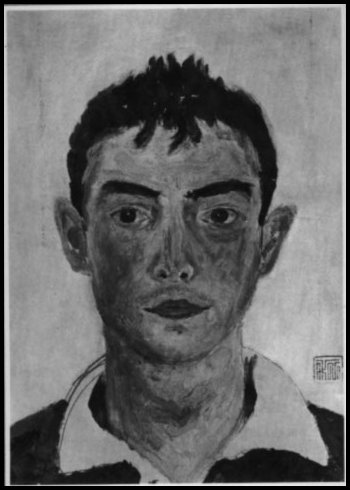
William Carlos Williams, self portrait, 1914 [pic courtesy of University at Buffalo]

from William Carlos Williams's "The Doctor" in The Little ReviewVol. V, Feb-Mar, 1919:

Once I came near drowning. I dived from a row-boat during a storm to recover my oars which I had lost, having “caught a crab.” I had light clothes on. I am not a very strong swimmer. I recovered one of the oars but the wind carried my boat away faster than I could follow. The waves were high. I swam as hard as I could until out of breath. My clothes began to drag. I tried to remove my shoes. I couldn't. I swallowed some water. I thought I was done for when there crossed my mind these sentences: So this is the end? What a waste of life to die so stupidly.

The thought was singularly emotionless, simply a clear vision of the situation. So much was this so that I was instantly sobered. My action taking on at once the quality of the thought, tucking the one oar under my left arm I swam quietly along hoping someone would see the empty boat and come out for me, which a man did. My courage, if you will, turned upon the color of my thought.


Thank you, Madge, for sending me this issue of The Little Review.

Sunday, January 13, 2013

13 enero 2012

Helen Frost [pic courtesy of Macmillan]

Helen Frost's Keesha's House (2007), which I learned of via Annie Finch, is a "young adult verse novel" (sestinas & sonnets) about how tough it is to be a teen. Wonderfully done.

from Louis Menand’s “Afterword, 2007: Anti-modern Eliot” in Discovering Modernism: T. S. Eliot and His Context (1987):

I think that literature is a report on experience, but I do not think that it is a privileged report on experience, and I do not think that it requires “close reading,” or closer reading than anything else requires, to be understood and appreciated. . . .

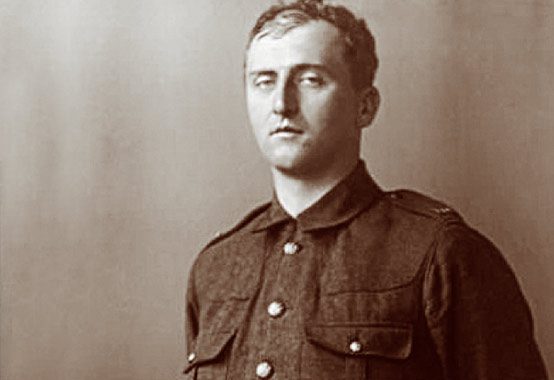
T. E. Hulme [pic courtesy of The American Conservative]

In “A Tory Philosophy” (1912), [T. E.] Hulme — following, he says [Pierre] Lasserre and [Charles] Maurras — contrasts a Rousseauistic romantic view, which he defines as the belief that “man, the individual, is an infinite reservoir of possibilities, and if you can so rearrange society by the destruction of oppressive order then these possibilities will have a chance and you will get Progress,” with “its exact opposite,” the classical view, which holds that “[m]an is an extraordinarily fixed and limited animal whose nature is absolutely constant. It is only by tradition and organization that anything decent can be got out of him.” . . .

Julien Benda [pic courtesy of krdys.com]

[from Julien Benda’s Belphégor: Essai sur l’esthétique de la présente société francaise (1918)]: [A]ll the literary attributes exalted by contemporary aesthetics are those with which women are most highly endowed, and which form a kind of monopoly of their sex; absence of general ideas, cult of the concrete and circumstantiated, swift and entirely intuitive perception, receptiveness to sentiment alone, interest centered on the self, the deepest, most intimate and most incommunicable self, etc. . . . The modern aesthetic is entirely made for women. Men struggle. Many try to imitate the literature of their rivals. Alas! They must succumb; there is a degree of unintellectuality and shamelessness to which they will never attain. . . .

For Eliot, the exclusion of “free-thinking Jews” from the ideal community share a homogenous cultural and religious tradition, and secondly of his desire that the tradition be Christian.

Zbigniew Herbert [pic courtesy of The Book Haven]

from Zbigniew Herbert’s Still Life with Bridle (1993):

I also patiently polished winding steps in the towers of Italian city halls and churches. But my efforts were rewarded only with something that could be called “a torso of a landscape” — splendid, of course splendid fragments. Later they became pale and I arranged them in my memory like postcards, these deceitful images with false colors and false light, untouched by emotion. . . .

In a state of alienation the eyes react quickly to objects and banal events that do not exist for the practical eye. I am surprised by the color of mailboxes . . .

For me nature that lacks compassion is the most beautiful: a cold world in another world. . . .

A good Sunday: garden walk, bicycle ride, melon harvest, cloudy & rainy, eating, napping. A little rabbit came to see us.


Now I'm making fresh jook from brown rice, almonds, carrot, cinnamon, coriander, curry, garlic, ginger, golden & black raisins, olive oil, onion, sage, spaghetti squash, tomato, zucchini, salt, pepper, & water. I throw it all in a pot & cook for at least two hours, until it's leaning toward mush.

Saturday, January 12, 2013

12 enero 2013

I dreamed I lived as an adult in a house with my parents. I went around unplugging televisions, throwing them outside, raging at my lack of a computer, cursing my father at every opportunity, loving a child, an animal.


Cumulopuntia boliviana, copana

Spent hours identifying this cactus that grew around Don Isidro's, the place we camped the first night of our trek.

Michel Houllebecq [pic courtesy of The Enthusiast]

from Michel Houellebecq’s Whatever, tr. Paul Hammond (1998):

Véronique was “in analysis,” as they say; today I regret ever having met her. Generally speaking, there’s nothing to be had from women in analysis. A woman fallen into the hands of the psychoanalysts becomes absolutely unfit for use, as I’ve discovered time and again. This phenomenon should not be taken as a secondary effect of psychoanalysis, but rather as its principal goal. Under the pretext of reconstructing the ego psychoanalysts proceed, in reality, to a scandalous destruction of the human being. Innocence, generosity, purity . . . all such things are rapidly crushed by their uncouth hands. Handsomely remunerated, pretentious and stupid, psychoanalysts reduce to absolute zero any aptitude in their so-called patients for love, be it mental or physical; in fact they behave as true enemies of mankind. A ruthless school of egoism, psychoanalysis cynically lays into decent, slightly fucked-up young women and transforms them into vile scumbags of such delirious egocentrism as to warrant nothing but well-earned contempt. On no account must any confidence be placed in a woman who’s passed through the hands of the psychoanalysts. Pettiness, egoism, arrogant stupidity, complete lack of moral sense, a chronic inability to love: there you have an exhaustive portrait of the ‘analysed’ woman.

Véronique, it has to be said, corresponded blow by blow to this description. I loved her — to the extent that it was within my power — which represents a lot of love. This love was poured down the drain. I now realize; I’d have done better to break both her arms. Like all depressives she doubtless always had a tendency towards egoism and a lack of feeling; but her psychoanalysis transformed her once and for all into a total shit, lacking both guts and conscience — a detritus wrapped in silver paper. I remember she had a white plastic board on which she ordinarily wrote things like ‘petits pois’ or ‘dry cleaners.’ One evening, coming back from her session, she’d noted down this phrase of Lacan’s: ‘the viler you are, the better it will be.’ I’d smiled; in this I was wrong. At this stage the phrase was still only a programme; but she was going to put it into practice, point by point.

Am slowly coming back to life after the Jujuy trek. My challenge is to eat enough food to make up for the calories burned away. Early this morning I walked for an hour, slowly. Later, two naps, gentle rain.

Friday, January 11, 2013

11 enero 2013

from Leslie Scalapino’s “ ‘Can’t’ is ‘Night’ ” in It’s go in horizontal: Selected Poems, 1974-2006 (2008):

the breaking of reason

        is silent seeing


European hare & burrowing owl

from Susan Howe’s My Emily Dickinson (1985):

Emily Dickinson once wrote to Thomas Wentworth Higginson: “Candor — my Preceptor — is the only wile.” . . .

Perception of an object means loosing and losing it. . . .

"My Life had stood — a Loaded Gun — ," written in a time of civil war by a woman with little formal education in philosophy, carefully delineates and declines all aspects of the "Will to Power" nearly twenty years before Friedrich Nietzsche's metaphysical rebellion. . . .

This is a frontier poem. Forester of New England wayward pilgrim. Trees have been stripped to the root by a seer on her path across circumference of intellection. This is a tragic poem. A pioneer's terse epic. Sorrow's melody is magic. Pitch of vowels, cadence of consonants, sound fused with sense — asceticism. For years I have wanted to find words to thank Emily Dickinson for the inspiration of her poetic daring.

Thursday, January 10, 2013

10 enero 2013


Walking Out

Walking down this
steep trail, I drone to myself:
Kent, I need to rest.
Juan, necesito descansar.
Twenty times, one
hundred, breath harsh
against my ears. My trekking
poles swing too far, not far
enough. I stumble
over tumbled rocks
square-cornered boulders
slick & tilted slabs.
A man-made trail
maintained by falling water.
My foot bones ache.

from Gilles Deleuze & Felix Guattari's A Thousand Plateaus: Capitalism and Schizophrenia, Tr. Brian Massumi (1987):

This body is stolen first from the girl: Stop behaving like that, you’re not a little girl anymore, you’re not a tomboy, etc. The girl’s becoming is stolen first, in order to impose a history, or prehistory, upon her. . . . The girl is certainly not defined by virginity; she is defined by a relation of movement and rest, speed and slowness

US in 2012: warmest year on record: NOAA

from Peter Gizzi's Some Values of Landscape and Weather (2003):

Beginning with a Phrase from Simone Weil

There is no better time than the present when we have lost everything. It doesn’t mean rain falling
at a certain declension, at a variable speed is without purpose or design.
The present everything is lost in time, according to laws of physics things shift
when we lose sight of a present,
when there is no more everything. No more presence in everything loved.

In the expanding model things slowly drift and everything better than the present is lost in no time.
A day mulches according to gravity
and the sow bug marches. Gone, the hinge cracks, the gate swings a breeze,
breeze contingent upon a grace opening to air,
velocity tied to winging clay. Every anything in its peculiar station.

The sun brightens as it bleaches, fades the spectral value in everything seen. And chaos is no better model
when we come adrift.
When we have lost a presence when there is no more everything. No more presence in everything loved,
losing anything to the present. I heard a fly buzz. I heard revealed nature,
cars in the street and the garbage, footprints of a world, every fly a perpetual window,
unalloyed life, gling, pinnacles of tar.

There is no better everything than loss when we have time. No lack in the present better than everything.
In this expanding model rain falls
according to laws of physics, things drift. And everything better than the present is gone
in no time. A certain declension, a variable speed.
Is there no better presence than loss?
A grace opening to air.
No better time than the present.

Simone Weil [pronounced Vay] [pic by Yann (Wikipedia)]

from Simone Weil's essay "Social Harmony" in Gravity and Grace (1952):

Whence will renewal come to us — to us who have defiled and emptied the whole earthly globe? . . .

As it cannot be expected that a man without grace should be just, there must be a society organized in such a way that injustices punish each other through a perpetual oscillation. . . .

A well ordered society would be one where the State had only a negative action, comparable to that of a rudder: a light pressure at the right moment to counteract the first suggestion of any loss of equilibrium. . . .

The great mistake of the Marxists and of the whole of the nineteenth century was to think that by walking straight on one mounted upwards into the air. . . .

After the collapse of our civilization there must be one of two things: either the whole of it will perish like the ancient civilizations, or it will adapt itself to a decentralized world.

It rests with us, not to break up the centralization (for it automatically goes on increasing like a snowball until the catastrophe comes), but to prepare for the future. . . .
You could not be born at a better period than the present, when we have lost everything.

more Deleuze & Guattari:

A book itself is a little machine; what is the relation (also measurable) of this literary machine to a war machine, love machine, revolutionary machine, etc. — and an abstract machine that sweeps them along? We have been criticized for overquoting literary authors. But when one writes, the only question is which other machine the literary machine can be plugged into, must be plugged into in order to work. Kleist and a mad war machine, Kafka and a most extraordinary bureaucratic machine . . . (What if one became animal or plant through literature, which certainly does not mean literarily? Is it not first through the voice that one becomes animal?) Literature is an assemblage. It has nothing to do with ideology. . . . Writing has nothing to do with signifying. It has to do with surveying, mapping, even realms that are yet to come.

Wednesday, January 9, 2013

Jujuy trek

Arrived home from my Jujuy trek @ 9:00 today, twelve hours late due to a road washout just south of La Viña.

Michael Cardew [pic courtesy of Literary Review]

This review of the biography of potter Michael Cardew reminded me that my friend Chris recently wrote: there are yogis all over the place, especially in the arts.

5-6 enero 2012 @ Posada de Luz in Tilcara:


Each room’s patio with small-rock floor, large-rock walls, a wooden table, slanted-back wood-framed chairs, canvas or wood-slat seats, mine canvas. I wonder whether the wood slats feel like a backrub. Beyond the patio close-cropped patchy grass. A hose wrapped around a rock pile.


Saturday night we walk the dirt roads that hold many signs of abandoned life — wire, nails, plastic, a shoe, a bottle, ribbon, a rolled-over toy, paper — not a scrap of it edible. Cats on walls, in windows. Thorn branches ring the plaza grass. No pisar en cesped. The dogs jump over. A huge cat ignores an investigating dog. Children play. A family passes round the maté cup.

Sunday morning I’m dressed & packed for the trek, waiting for breakfast & hot water for tea. Am so excited & so full of complaints.

Last night I drank half a bottle of Malbec with my excellent chunks-of-lamb-on-a-stick dinner. Felt unsafe going to sleep with the garden doors open. The little window — a 12” square mosquito highway — was too small for ventilation. I arranged the four pillows around & under me like small bodies. Hardly slept.

Early roosters, dogs, all-night party-ers, car horns, birds, a flutter of doves. Once the dogs start it’s nonstop. Greeting or warnings. A cat skedaddles away from me on my 7 AM ramble. When the dogs stop, it’s only birds & distant traffic. Silence of VL, not RL. A popgun shot, dogs in waves, a two-stroke motor, a late rooster.


Knipfolia — lots. Also a plant with dark-pink, impatiens-like flowers that open only at night. Under a molle dozens of small white feathers. A tall molle with a 6-foot-diameter boll. On it a plaque: O.E.P.D. Santos Manfredi III & a date. Brother Santos & sister Luz — Saints & Light — own Posada de Luz.

I’m hungry, eating a nut bar, wearing lightweight clothing, arms covered. Sun shines on the western hills. The pink night flowers are still open, the day beautiful. A tiny yellow bird with a black tail carries twigs for a nest. Three trunks grow from the fallen & standing walnut — nogal, one trunk dead & mistletoed. Plant bits fall onto my shirt. The western mountains cloudy, eastern clear. Dawn’s cloud cover thins to blue. The air so pure, dry, still with morning. Bells. From the church? Sunday morning early mass?


A concrete-clad brick chimney topped by a roof-metal slab topped by a water tank — nothing level.


The graphic on my door, a fish; on Kent's door, a man.

My teeth are brushed. Kent’s up & ready for breakfast — café con leche, medialunas with butter, fresh-squeezed orange juice, fresh-fruit salad — banana, apple, kiwi, peach, plum, strawberry, orange juice.

Squeals, howls, barks, yips. Kent tells me the shepherd who lives in the mountains west & south of Cafayate keeps 15 dogs to keep away the pumas, which would otherwise eat the chickens, goats, sheep, cows, a smaller herd of dogs.

In my pockets a cotton handkerchief, a toothpick, an iPhone, after-meal pills. On my back a very light pack containing a 1.8-liter water bladder, binoculars, a Swiss army knife, a green apple, three nut bars, two squares of chocolate. Around my neck a camera. I believe we head out east & south.

Saturday, January 5, 2013

5 enero 2013

after we shut her out of the bedroom, Miss Vee let herself out by the cat door
sometime between five & six AM; am final packing for my trek

John Wieners [pic courtesy of Allen Ginsberg]


The Acts of Youth

And with great fear I inhabit the middle of the night
What wrecks of the mind await me, what drugs
to dull the senses, what little I have left,
what more can be taken away?

The fear of travelling, of the future without hope
or buoy. I must get away from this place and see
that there is no fear without me: that it is within
unless it be some sudden act or calamity

to land me in the hospital, a total wreck, without
memory again; or worse still, behind bars. If
I could just get out of the country. Some place
where one can eat the lotus in peace.

For in this country it is terror, poverty awaits; or
am I a marked man, my life to be a lesson
or experience to those young who would trod
the same path, without God

unless he be one of justice, to wreak vengeance
on the acts committed while young under un-
due influence or circumstance. Oh I have
always seen my life as drama, patterned

after those who met with disaster or doom.
Is my mind being taken away me.
I have been over the abyss before. What
is that ringing in my ears that tells me

all is nigh, is naught but the roaring of the winter wind.
Woe to those homeless who are out on this night.
Woe to those crimes committed from which we
can walk away unharmed.

So I turn on the light
And smoke rings rise in the air.
Do not think of the future; there is none.
But the formula all great art is made of.

Pain and suffering. Give me the strength
to bear it, to enter those places where the
great animals are caged. And we can live
at peace by their side. A bride to the burden

that no god imposes but knows we have the means
to sustain its force unto the end of our days.
For that is what we are made for; for that
we are created. Until the dark hours are done.

And we rise again in the dawn.
Infinite particles of the divine sun, now
worshipped in the pitches of the night.

hasta luego . . .