Saturday, February 22, 2014

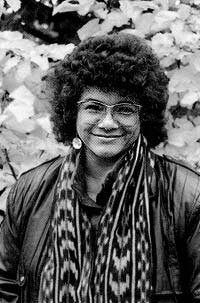
María Melendez

María Melendez [Poetry Society of America]

from María Melendez's Flexible Bones:

The Fifth Apparition: Reno

Out a casino basement like a Stone Age
mamacita on a suited man's arm, terra cotta
silk dress with only one shoulder strap, wide
like a hide curving off her back and down
across her ostrich-egg breasts —

Dare we number the feathered angels
and bare devils revolving in a waltz
on that slick shoulder ball?

(Faced with a modest blue
cotton shift, we might guess
her fate lay in giving, we'd
associated motherly verbs: bathe,
mollify, hallow, salve.) To hell

with egg-shaped, she's nobody's —
in that owning-it-all look
she tosses at the streets, in the
tall spikes tethered to her feet —

she offers no succor, no
slack mud to plow, she's out
to kill sweet things
that eat Her in pieces,
to kick in any
scavenging teeth.


Love Song for a War God

Every part of you contains a secret language.
Your hands and feet detail what you've done.
Your appetite is great, and like the sea,
you constantly advance, lunge after lunge.

Unlike my brother sleeping in his chair,
you do not take reality with ease.
Your pain builds up its body like a cloud
rotating a collage of hot debris.

O Teacher! We have learned that all men's tears
are not created equal. We were wrong
to offer flames to quell your fires. Still,
I must dismember you inside this song.

Your mouth's dark cave awaits Victory's kiss;
blood is the lid your calm eyes never lift.

Thursday, February 20, 2014

20 February 2014


Canto 7

Don’t be duped —
Girl Guide Virgil was paid
to lead Dante tenderfoot

round the grades
of Malebolge —
the duo’s holier-than-Abel pride

plugs my gorge
particularly
in our modernest age

when all the mugs we see
are Popist-hypocrites
& prinked celebrities

spectator-sport publicists
& weather-casters
TV-pundits

nation-staters
drug-peddling scientists
Monsanto farmers

latter-day-haintists
the tail
of lawmaker-capitalists —

all hail
monsters, aka honest Geryon
good for annulling

bitter tongue
greased by rings of blooded victims
churchly spun.

Wednesday, February 19, 2014

19 February 2014

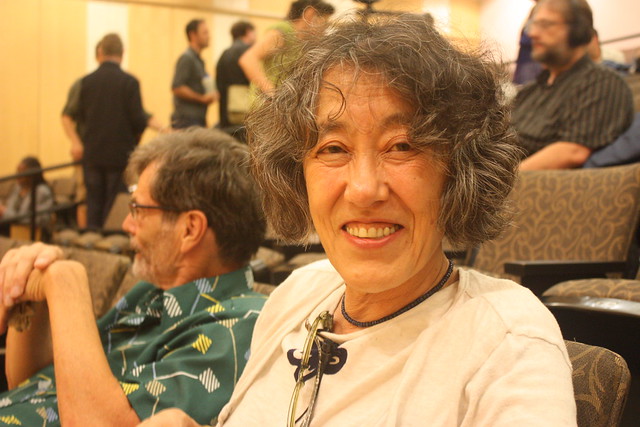
Jennifer Chang [Kimmel Harding Nelson Center for the Arts]

from Jennifer Chang's The History of Anonymity:

And the night illuminated the night

No one sees how night fades you.

Not the stars' lambent sparks —

born blind, light years gone.
Even you don't see

                                    the black line of yourself,
the vanishing

you slowly come to, a shadow gift.

You're the kind
who walks into a forest
and becomes

                          indistinguishable from the trees.
Find a ghost reflection

in the field
flooded
with the moon's graylight — why is splendor

            so ordinary?

Be branch and dirt,
be stiff as your oak skin, oak heart.

No one led you here, 
only dark curiosity, the trail

trained to lose you.
Inside, you have a longing

but it is hard.

                           You could have been odd,

a fiddlehead: embryonic
and translucent, it waits to unfurl,

to spore. You could have been a white thread
tangled in the grass,

a thing that feigns glowing,
a thing that feigns.


Pastoral

Friday, February 14, 2014

Roberta Hill Whiteman

Roberta Hill Whiteman [hanksville]

from Roberta Hill Whiteman's Star Quilt:

The Recognition

We learn too late the useless way light leaves
footprints of its own. We traveled miles to Kilgore
in the submarine closeness of a car. Sand hills
recalling the sea. A coyote slipped across the road
before we knew. Night, the first skin around him.
He was coming from the river
where laughter calls out fish. Quietly a heavy wind
breaks against cedar. He doubled back,
curious, to meet the humming moons we rode
in this gully, without grass or stars. Our footprints
were foreign to him. He understood the light
and paused before the right front wheel, a shadow
of the mineral earth, pine air in his fur.
Such dogs avoid our eyes, yet he recognized and held
my gaze. A being both so terrible and shy
it made my blood desperate
for the space he lived in:
broad water cutting terraced canyons,
and ice gleaming under hawthorne like a floor of scales.
Thick river, remember we were light thanking light,
slow music rising. Trees perhaps, or my own voice
out of tune. I danced a human claim for him
in this gully. No stars. He slipped
by us, old as breath, moving in the rushing dark
like moonlight through tamarack,
wave on wave of unknown country.
Crazed, I can’t get close enough
to this tumble wild and tangled miracle.
Night is the first skin around me.

Thursday, February 13, 2014

Alfred Kreymborg

Alfred Kreymborg [Poetry Foundation]

from Alfred Kreymborg's autobiography, Troubadour:

One day, shortly before the printing press was due, a bizarre, special-delivery package, post-marked London, arrived in Grantwood. The cover resembled the stout paper butchers use for wrapping meat. Krimmie [aka the author, writing of himself in the third person] untied the parcel, and a sheaf of manuscripts of various dimensions, edited with bold, marginal notes and caustic instructions, emerged. A vigorous letter, in a large confident scrawl, warned Krimmie "that unless you're another American ass, you'll set this up just as it stands!" In a postscript, Pound added promises of further material provided The Glebe behaved itself and its editors didn't dash his faith by degenerating into some Puritanical policy. . . . Krimmie readily understood why poets attached themselves to Pound. In a world where most people slavishly coddled their own egos, here was a fellow with a heart and intelligence at the service of other contemporaries.

The pages he held in his hands and leafed over and over were an exotic manifestation of something extraordinarily alive and beautiful. Outside of an Elizabethan lyric by an unknown, named James Joyce, nearly all of the pieces moved without rhyme or a traditional metre. There were even some bits of prose, Chinese prose poems by Allen Upward, and a rollicking satire on the fogs of London by the irrepressible Ponce de Leon, Ford Madox Hueffer. The bulk and most beguiling of the manuscripts had been contributed by H. D., Aldington, Flint, Cannéll and Pound. There was a single poem by Amy Lowell and a single poem (in the Greek manner) by William Carlos Williams, who, Pound wrote, "is my one remaining pal in America — get in touch with old Bull — he lives in a hole called Rutherford, New Jersey." The title the editor insisted must go on the cover read: Des Imagistes, An Anthology.

Man [Ray] and Krimmie indulged in a delirious war-dance. They would run these poems as the very first issue of The Glebe. But they were doomed to a tragic disappointment. On a Saturday afternoon, the printing press arrived in a small cart dragged by an aged horse and driven by two wizened men. It had come from downtown Manhattan, across the Fulton Street Ferry, up the Jersey banks of the Hudson, over the Palisades and down to the shack without mishap. Then, in removing the press, the old men were just careless enough to let it slip to the ground between them, and an excited examination disclosed that only the most important parts were broken. If the editors cared to go to a certain expense, the damage could be repaired. But as usual, neither Man nor Krimmie, nor Man and Krimmie combined, had the requisite funds. . . .

On a Sunday, quite a group would make the trip out to Grantwood, bring their own bundles of lunch, distribute the contents and then loll about on the hillside rolling away from the shack. Bringing these bundles saved Christine [Krimmie's wife] a good deal of labor and Krimmie a good deal of expense. It was never a solemn crowd that arrived — in ones and twos and threes. Nor did all of them make the trip from the other side of the Hudson. One man, looking like Don Quixote de la Mancha driving the rusty Rosinante, came in a battered, two-seated Ford. Though the actual place he started from was an ugly little town called Rutherford, there was enough of the Spaniard in his blood and the madman in his eye and profile to have warranted the comparison. Whenever he climbed down from the saddle, with an oath or a blessing, he disclosed the bold or bashful features of Ezra Pound's old and Krimmie's new friend, Dr. William Carlos Williams. It was for Bill, even more than any of the others, Krimmie would steal outdoors, shade his eyes and watch for a cloud of dust along the horizon.

Mary Carolyn Davies, a lanky Oregonian, undertook the journey from a sort of settlement house on the lower westside, accompanied now and then by an astonishing person with Titian hair, a brilliant complexion and a mellifluous flow of polysyllables which held every man in awe. Marianne Moore talked as she wrote and wrote as she talked, and the consummate ease of the performance either way reminded one of the rapids of an intelligent stream. . . .

[some years later]

Krimmie insisted on being driven straight to Amherst, without the slightest forewarning to the author of North Of Boston, whom he had never met and with whom he hadn't even corresponded. Marion Sheffield led Krimmie into her car, and urged on by her excited guest, broke several records en route. After many questions put to pedestrians, who confessed they had never heard of Mr. Frost, a farmer directed the wayfarers to an obscure cottage just out of town. Mrs. Frost, who graciously received them at the door, directed them to a tennis court where they would find "Robert" in a desperate engagement with his eldest son. Krimmie stole up behind the man whose work he admired as much as that of anyone writing English at the time, and with a preliminary, "Pardon me for disturbing you, sir," introduced his hostess and himself. "Holy Smoke," returned Mr. Frost, dropping his racket, grabbing Krimmie by the arm and leading the way back to the cottage.

For something like eight or nine hours, Robert and Krimmie gossiped without interruption. Marion Sheffield had to depart without her guest, leaving him to the tender mercies of his new hosts. But there was no such mercy in Robert. He wanted to know everything about everybody and Krimmie was so completely captivated that he talked as he had never talked before. To his astonishment, he learned that Robert had been reading various issues of Others [Kreymborg's latest literary journal] to his classes, "just to keep the boys alive to new doings," and that Lima Beans [one of Kreymborg's plays] had been one of the exhibits. Krimmie regaled his host with affectionate portraits of Williams, Bodenheim, Marianne Moore, Stevens and others. In the midst of the general excitement, Robert, with a far-away expression Krimmie soon learned was habitual with the New Englander, asked: "I wonder do you feel as badly as I do when some other fellow does a good piece of work?" Krimmie nodded with pleasure, and Robert added: "But let him attack such a man and I'm up in arms for him."

At two or three in the morning, the gossips were still at it, and had to be shooed off to bed, but at seven, Robert knocked at Krimmie's door, dragged him off to breakfast and they started all over again. The two men parted on a note of intimacy which no circumstance has ever altered. Many a time later on, when Krimmie learned that someone had been saying things behind his back — fine things in quarters that benefited him — he discovered that the instigator of these subtle attentions was the man he had disturbed in his lair down east. He rarely heard from the hermit — except through such indirect channels.

Wednesday, February 12, 2014

Wallace Stevens

Castilleja exserta, purple owl's clover [Conejo Open Space Foundation]

from Wallace Stevens's Owl’s Clover:

Life on a Battleship [excerpt]

The war between classes is
A preliminary, a provincial phase,
Of the war between individuals. In time,
When earth has become a paradise, it will be
A paradise full of assassins.

12 February 2014

Aizoaceae, lithops, from λίθος [photo by Janis Fullan]


This Falling

It's gray, then suddenly bright, gray
first dry day after four of rain, it’s undecided
cloud or light stay.

Retirement, a loss of companions
not so much friends as presence
like children, same-age child at the desk ahead.

Lagoon & channel run low despite rain
something else
mechanical draining the banks.

Powered by downs
a shape on a bicycle slingshots
home-school these tests, this falling.

On an average day it’s not likely
a friend will be dealt
cards, a lark, mirror of like, of unlike.

First & last are best, take this
two heels, two spoons of broth, two sips of tea
or this, the idea of lunch.

County worker in chartreuse pinny
officer in serge pants
shorebirds grub mud for honey.

Like glass, few friendships thrive
most age, go to pieces.
The trees hide more once they leaf.

Tuesday, February 11, 2014

Mei-mei Berssenbrugge

Mei-mei Berssenbrugge [Steve Evans]


Glitter

1.

A wood violet has bloomed, when I come back from my walk in early spring.

I stop and welcome it, cooing, walking around it, not as if I were floating, but the surface of the world circled unfurling petals.

Person and violet with so little in common my voice reveals as a resonance of unmanifest identify.

The violet looking back, loses objectivity and enters the expansion of recognized things.

You could say our identities reach out to encompass the forest environment, like telepathy: a moment opens space by rendering it transparent in intensified consciousness.

Others embrace weather and wild land as their means to the supra-sensible; in violets, it’s emotional desire for spring light: glitter, the mirror.

Connection, often the form emotion takes, appears to me as a visual image.

2.

Thoughts are sent out by one rock informing other rocks as to the nature of its changing environment, the angle of sun and temperatures cooling as night falls, and even its (loosely called) emotional tone changes, the appearance of a person walking, who’s not appropriately empathic.

Thoughts meet and merge with other thoughts sent out, say, from foliage and other entities.

I tell you, your own thoughts and words can appear to inhabitants of other systems like stars and planets to us.

Intensities of thought, light and shadow between us, contain memories coiled, one within the other, through which I travel to you, and yet are beautifully undetermined.

For what you say to me is not finished within my thought or memory, but you grow there and change, the way a shadow extends as light passes over it in Akashic emptiness.

You grow through what I have to say to you, as a tree grows up through space, then what I have to say changes.

That’s why we need the identity of our physical forms.

Here, we don’t know what’s behind physical stars and planets.

3.

The tree encompasses its changing form, while ego, my self of physical experience, looks in the past for something to recognize.

When he looks into my eyes, she said, I see adoration that makes me feel wonderful.

Then, I can do things.

Here we mean sun, alteration, myself are actions.

Imbalance between identity’s wish to maintain and intrinsic drives results in the exquisite by-product, consciousness of self, so richly creating a reality that seems plastic, but continues like a light beam, an endless series of beams.

Creativity breaks through identity, and my awareness flows through transparency as spontaneous synchronous phenomena experienced with others today.

Its light and weather spectacles are fantastically aesthetic.

4.

The moment it sees me, the violet grows more deeply purple and luminous to me.

Its looking collapses violet frequency into a violet in the world, cohering attention and feeling.

What I perceive as a flower in woods may be the shadow of a flower-being’s action in fairyland, a transcendent domain of potentia.

Transparency I imagine moving through is being through, not actually seen or touched, not the buzzing of a million invisible bees.

What you call feeling, like connective tissue or vibrating lines between us, represents this vitality.

And I prefer the term vitality to time.

In fairyland, all violets are simultaneous.

Monday, February 10, 2014

Bin Ramke

Bin Ramke [Poetry Foundation]

from Bin Ramke's Aerial:

A Measured Narrowness

The hare's breath trembled the
leaf before the teeth devoured
narrowness of space between
hungers. Wretched rabbit.
A minuscule mind mattering
is a thing, is a smallness
of thing this lovely evening
when we sit on stones and
light creases the grasses before
us. Parkland. Seasons. A thing
called cognitive dysmetria applies
so every rabbit reduces — distinguish
hare from rabbit, light from
even lighter. Hispid Hare with
her little leverets bounding.
The leporid, or so
I imagine, is under this turf
with altricial babies, worrying.
What we call them,
Lagomorphs, part of the world.
Who says it, and why, and whether
"matter" means to make into
world what was only mind before:
orography, hill writing, makes clouds;
makes clouds rain. The little molecules
rabbitly rattling down the tin roof;
but the rabbits are safe in their holes
and the hares are faster than lightning,
and the writers all rigor and rightness.

Friday, February 7, 2014

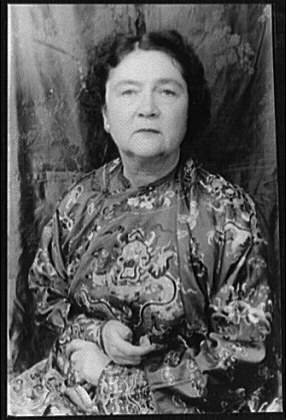
Marjorie Kinnan Rawlings

Marjorie Kinnan Rawlings [Wikipedia]

from Marjorie Kinnan Rawlings's Cross Creek:

I do not understand how any one can live without some small place of enchantment to turn to. In the lakeside hammock there is a constant stirring in the tree-tops, as though on the stillest days the breathing of the earth is yet audible. The Spanish moss sways a little always. The heavy forest thins into occasional great trees, live oaks and palms and pines. In spring, the yellow jessamine is heavy on the air, in summer the red trumpet vine shouts from the gray trunks, and in autumn and winter the holly berries are small bright lamps in the half-light. The squirrels are unafraid, and here I saw my first fox-squirrel, a huge fellow made of black shining plush. Here a skunk prowled close to me, digging industrious small holes for grubs. I sat as still as a stump, and if he saw me, as I suspect, he was a gentleman and went on steadily with his business, then loped away with a graceful rocking motion. A covey of quail passed me often, so that I came to know their trail into the blackberry thicket where they gathered in a circle for the night, making small soft cries. It is impossible to be among the woods animals on their own ground without a feeling of expanding one's own world, as when any foreign country is visited.

To the west, the hammock becomes damp, the trees stand more sparsely. Beyond is a long stretch of marsh where the cattle feed lazily, belly-deep in water hyacinths and lily pads, then the wide lake itself. There is a clamor of water birds, long-legged herons and cranes, visiting sea-gulls from the coasts, wild ducks, coots, the shrill scream of fish-hawks, with now and then a bald-headed eagle loitering in the sky, ready to swirl down and take the fish-hawk's catch from him in midair. Across the lake, visible the four miles only on a clear day, is the tower of the old Samson manse, decaying in the middle of the still prosperous orange grove. From the tower itself, decrepit and dangerous, is a sight of a tropical world of dreams, made up of glossy trees and shining water and palm islands. When I am an old woman, so that too much queerness will seem a natural thing, I mean to build a tower like it on my own side of the lake, and I shall sit there on angry days and growl down at any one who disturbs me.

I dig leaf mould from this hammock to enrich my roses and camellias and gardenias. When I went with my basket one morning a breath of movement, an unwonted pattern of color, caught my eye under a tangle of wild grapevines. A wild sow lay nested at the base of a great magnolia. At a little distance, piled one on the other, lay her litter, clean and fresh as the sunshine, the birth-damp still upon them. Sow and litter were exhausted with the business of birthing. The one lay breathing profoundly, absorbed in the immensity of rest. The others lay like a mass of puppies, the lowest-layered tugging himself free to climb again on top of the pile and warm his tender belly. The mass shifted. The most adventuresome, a pied morsel of pig with a white band like a belt around his middle, wobbled over to the sow's side. He gave a delighted whimper and the whole litter ambled over to discover the miracle of the hairy breasts.

The jungle hammock breathed. Life went through the moss-hung forest, the swamp, the cypresses, through the wild sow and her young, through me, in its continuous chain. We were all one with the silent pulsing. This was the thing that was important, the cycle of life, with birth and death merging one into the other in an imperceptible twilight and an insubstantial dawn. The universe breathed, and the world inside it breathed the same breath. This was the cosmic life, with suns and moons to make it lovely. It was important only to keep close enough to the pulse to feel its rhythm, to be comforted by its steadiness, to know that Life is vital, and one's own minute living a torn fragment of the larger cloth.

Wednesday, February 5, 2014

5 February 2014

photo by Mike Smith, Onekahakaha Beach, Hilo, Hawaii

ribbon is a girl thing
like a dress
pompoms of
streamers, shreds
ribbons threaded in cloth
of road, of drool
how to smooth
the wrinkles knots make

Monday, February 3, 2014

3 February 2014

J. M. Coetzee [timesunion]


‘Very well. You find me attractive, I can see that. Perhaps you even find me beautiful. And because you find me beautiful, your appetite, your impulse, is to embrace me. Do I read the signs correctly, the signs you give me? Whereas if you did not find me beautiful you would feel no such impulse.’

He is silent.

‘The more beautiful you find me, the more urgent becomes your appetite. That is how these appetites work which you take as your lodestar and blindly follow. Now reflect. What — pray tell me — has beauty to do with the embrace you want me to submit to? What is the connection between the one and the other? Explain.’

He is silent, more than silent. He is dumbfounded.

‘Go on. You said you would not mind if your godson heard. You said you wanted him to learn about life.’

‘Between a man and a woman,’ he says at last, ‘there sometimes springs up a natural attraction, unforeseen, unpremeditated. The two find each other attractive or even, to use the other word, beautiful. The woman more beautiful than the man, usually. Why the one should follow the other, the attraction and the desire to embrace from the beauty, is a mystery which I cannot explain except to say that being drawn to a woman is the only tribute that I, my physical self, know how to pay to the woman’s beauty. I call it a tribute because I feel it to be an offering, not an insult.’

He pauses. ‘Go on,’ she says.

‘That is all I want to say.’

‘That is all. And as a tribute to me — an offering, not an insult — you want to grip me tight and push part of your body into me. As a tribute, you claim. I am baffled. To me the whole business seems absurd — absurd for you to want to perform, and absurd for me to permit.’

‘It is only when you put it that way that it seems absurd. In itself it is not absurd. It cannot be absurd, since it is a natural desire of the natural body. It is nature speaking in us. It is the way things are. The way things are cannot be absurd.’

‘Really? What if I were to say that to me it seems not just absurd but ugly too?’

He shakes his head in disbelief. ‘You cannot mean that. I myself may seem old and unattractive — I and my desires. But surely you cannot believe that nature itself is ugly.’

‘Yes, I can. Nature can partake of the beautiful but nature can partake of the ugly too. Those parts of our bodies that you modestly do not name, not in your godson’s hearing: do you find them beautiful?’

‘In themselves? No, in themselves they are not beautiful. It is the whole that is beautiful, not the parts.’

‘And these parts that are not beautiful — you want to push them inside me! What should I think of that?’

‘I don’t know. Tell me what you think.’

‘That all your fine talk of paying tribute to beauty is una tontería. If you found me to be an incarnation of the good, you would not want to perform such an act on me. So why wish to do so if I am an incarnation of the beautiful? Is the beautiful inferior to the good? Explain.’

‘Una tontería: what’s that?’

‘Nonsense. Rubbish.’

He gets to his feet. ‘I am not going to excuse myself further, Ana. I don’t find this to be a profitable discussion I don’t believe you know what you are talking about.’

‘Really? You think I am some ignorant child?’

‘You may not be a child but, yes, I do think you are ignorant of life. Come,’ he says to the boy, taking his hand. ‘We have had our picnic, now it is time to thank the lady and go off and find ourselves something to eat.’

Ana reclines, stretches out her legs, folds her hands in her lap, smiles up at him mockingly. ‘Too close to the bone, was it?’ she says.

3 February 2014

William Jackson Hooker [Harvard University Herbaria]


On the cloth was nothing but a plate, a knife and fork, a wine glass, and a bottle of claret, for each guest, except that in the middle stood a large and handsome glass-castor of sugar, with a magnificent silver top. The natives are not in the habit of drinking malt liquor or water, nor is it customary to eat salt with their meals. The dishes are brought in singly: our first was a large turenne of soup, which is a favorite addition to the dinners of the richer people, and is made of sago, claret, and raisins, boiled so as to become almost a mucilage. We were helped to two soup-plates full of this, which we ate without knowing if any thing more was to come. No sooner, however, was the soup removed, than two large salmon, boiled and cut in slices, were brought on, and, with them, melted butter, looking like oil, mixed with vinegar and pepper; this, likewise, was very good, and we with some difficulty cleared our plates, earnestly hoping we had finished our dinners. Not so; for there was then introduced a turenne full of the eggs of the Cree, or great tern, boiled hard, of which a dozen were put upon each of our plates; and, for sauce, we had a large basin of cream, mixed with sugar, in which were four spoons, so that we all ate out of the same bowl, placed in the middle of the table. We petitioned hard to be excused from eating the whole of the eggs upon our plates, but we petitioned in vain. "You are my guests," said he," and this is the first time you have done me the honor of a visit, therefore, you must do as I would have you; in future, when you come to see me, you may do as you like." In his own excuse, he pleaded his age for not following our example, to which we could make no reply. We devoured with difficulty our eggs and cream; but had no sooner dismissed our plates, than half a sheep, well roasted, came on, with a mess of sorrel (Rumex acetosa), called by the Danes scurvy-grass, boiled, meshed, and sweetened with sugar. It was to no purpose we assured our host that we had already eaten more than would do us good: he filled our plates with the mutton and sauce, and made us get through it as well as we could; although any one of the dishes, of which we had before partaken, was sufficient for the dinner of a moderate man. However, even this was not al ; for a large dish of Waffels, as they are here called, that is to say, a sort of pancake, made of wheat-flour, flat, and roasted in a mould, which forms a number of squares on the top, succeeded the mutton. They were not more than half an inch thick, and about the size of an octavo book. The Stiftsamptman said he would be satisfied if each of us would eat two of them, and, with these moderate terms, we were forced to comply. For bread, Norway biscuit and loaves made of rye, were served up; for our drink, we had nothing but claret, of which we were all compelled to empty the bottle that stood by us, and this, too, out of tumblers, rather than wine glasses. It is not the custom in this country to sit after dinner over the wine, but we had, instead of it, to drink just as much coffee as our host thought proper to give us. The coffee was certainly extremely good, and, we trusted it would terminate the feast; but all was not yet over ; for a huge bowl of rum- punch was brought in, and handed round in large glasses pretty freely, and to every glass a toast was given. If at any time we flagged in drinking, "Baron Banks" was always the signal for emptying our glasses, in order that we might have them filled with bumpers, to drink to his health; a task that no Englishman ought to hesitate about complying with most gladly, though assuredly, if any exception might be made to such a rule, it would be in an instance like the present. We were threatened with still another bowl, after we should have drained this; and, accordingly, another actually came, which we were with difficulty allowed to refuse to empty entirely; nor could this be done, but by ordering our people to get the boat ready for our departure, when, having concluded this extraordinary feast by three cups of tea each, we took our leave, and reached Reikevig about ten o'clock; but did not for some time recover from the effects of this most involuntary intemperance.

Sunday, February 2, 2014

W. H. Auden & Louis MacNeice

W. H. Auden & Louis MacNeice in Iceland [coup!]


a letter from WHA to Christopher Isherwood [excerpt]

If you have no particular intellectual interests or ambitions and are content with the company of your family and friends, then life on Iceland must be very pleasant, because the inhabitants are friendly, tolerant and sane. They are genuinely proud of their country and its history, but without the least trace of hysterical nationalism. I always found that they welcomed criticism. But I had the feeling, also, that for myself it was already too late. We are all too deeply involved with Europe to be able, or even to wish to escape. Though I am sure you would enjoy a visit as much as I did, I think that, in the long run, the Scandinavian sanity would be too much for you, as it is for me. The truth is, we are both only really happy living among lunatics. . . .

For Tourists [excerpt]

Food.

In the larger hotels in Reykjavik you will of course get ordinary European food, but in the farms you will only get what there is, which is on the whole rather peculiar.

Breakfast: (9.0 a.m.) If you stay in a farm this will be brought to you in bed. Coffee, bread and cheese, and small cakes. Coffee, which is drunk all through the day — I must have drunk about 1,500 cups in three months — is generally good. There is white bread, brown bread, rock-hard but quite edible, and unleavened rye bread like cake. The ordinary cheese is like a strong Dutch and good. There is also a brown sweet cheese, like the Norwegian. I don’t like cakes so I never ate any, but other people say they are good.

Lunch and Dinner: (12 noon and 7 p.m.). If you are staying anywhere, lunch is the chief meal, but farmers are always willing to give you a chief meal at any time of the day or night if you care. (I once had supper at 11 p.m.).

Soups: Many of these are sweet and very unfortunate. I remember three with particular horror, one of sweet milk and hard macaroni, one tasting of hot marzipan, and one of scented hair oil. (But there is a good sweet soup, raspberry coloured, made of bilberry. L. M.)

Fish: Dried fish is a staple food in Iceland. This should be shredded with the fingers and eaten with butter. It varies in toughness. The tougher kind tastes like toe-nails, and the softer kind like the skin off the soles of one’s feet.

In districts where salmon are caught, or round the coast, you get excellent fish, the grilled salmon particularly.

Meat: This is practically confined to mutton in various forms. The Danes have influenced Icelandic cooking, and to no advantage. Meat is liable to be served up in glutinous and half-cold lumps, covered with tasteless gravy. At the poorer farms you will get only Hángikyrl, i.e. smoked mutton. This comparatively harmless when cold as it only tastes like soot, but it would take a very hungry man indeed to eat it hot.

Vegetables: Apart from potatoes, these, in the earlier part of the summer are conspicuous by their absence. Later, however, there are radishes, turnips, carrots, and lettuce in sweet milk. Newish potatoes begin to appear about the end of August. Boiled potatoes are eaten with melted butter, but beware of the browned potatoes, as they are coated in sugar, another Danish barbarism.

Fruit: None, except rhubarb and in the late summer excellent bilberries.

Cold food: Following the Scandinavian custom, in the hotels, following the hot dish there are a number of dishes of cold meats and fishes eaten with bread and butter. Most of these are good, particularly the pickled herring. Smoked salmon in my opinion is an overrated dish, but it is common for those who appreciate it.

Sweets: The standard sweet is skyr, a cross between Devonshire cream and a cream cheese, which is eaten with sugar and cream. It is very filling but most people like it very much. It is not advisable, however, to take coffee and skyr together just before riding, as it gives you diarrhoea.

Tea: (4 p.m.). Coffee, cakes, and if you are lucky, pancakes with cream. These are wafer-thick and extremely good. Coffee and cake are also often brought to you in the evening, about 10 p.m. Those who like tea or cocoa should bring it with them and supervise the making of it themselves. . . .

Oddities

For the curious there are two Icelandic foods which should certainly be tried. One is Hákarl, which is half-dry, half-rotten shark. This is white inside with a prickly horn rind outside, as tough as an old boot. Owing to the smell it has to be eaten out of doors. It is shaved off with a knife and eaten with brandy. It tastes more like boot-polish than anything else I can think of. The other is Reyngi. This is the tail of the whale, which is pickled in sour milk for a year or so. If you intend to try it, do not visit a whaling station first. Incidently, talking about pickling in sour milk, the Icelanders also do this to sheeps’ udders, and the result is surprisingly very nice.

Saturday, February 1, 2014

Blood Turns Red Only When It Meets Oxygen


Blood Turns Red Only When It Meets Oxygen

the cattle-egret-to-cow ratio
is 12-to-2 in this pasture, 0-to-6 in that
seldom one outrider to one keel

claiming blood turns red only when it meets oxygen
is like saying you know you’re dead
after you’ve died
or you’re asleep when you’re dreaming

palm litter — fronds, flowers, seeds —
ironwood needles at cliff edge
white foam, black rocks, blue horizon

the catch in my throat is asthma
always some body part refusing its job

all night a cow cried
may it not have lost its calf
may it not have strayed into the stream

remain as long as it takes for rain to fall
abraded, debrided, dehisced
by absence of rain

the cow with the newborn calf
the cow with the fuzzy calf
the heifer with egrets parked between its ears

everything about someone
is shown by the size of the triangle
they turn to mark a page

I wake to rain’s in breath, stirring
like water coming to simmer
irregular strike, plops of water

may more & more cows sing to my old age