Thursday, January 16, 2014

16 January 2014

Karen Solie [National Post]

from Karen Solie's Short Haul Engine:

Dry Mother

Little brother, seeing
that blind wall approach,
his tricycle flipped end over end,
asks if it's the end of the world.

We who live here
in the lap of this dry mother
know from our beginnings that it will come in dust.
Have heard those drifts
that trouble the fenceline in daylight
wash around the house after dark
reminding us of how a good rain sounds
like the suck and hiss of fire.
Mornings, we've seen perennials dead
even on the lee side and have feared
the loss of each other
to shrouds of our own land spun
by wind that will not stop.

But it does this time, as before.
Another calm apology
for seed planted in door frames,
these newly-hatched sparrows
choked by earth
that leapt up to bury them.

Tuesday, January 14, 2014

Jean Valentine

Jean Valentine [Radcliffe Institute]

from Jean Valentine's Door in the Mountain: New and Collected Poems, 1965-2003:

Waiting

Ask, and let your words diminish your asking,
As your journal has diminished your days,
With the next day's vanity drying your blood,
The words you have lost in your notebooks.
Ask — do not be afraid. Praise Him for His silence.

What I love to ask is what I know,
Old thoughts that fit like a boot.
What I would hazard clings in my skull:
Pride intervenes, like an eyelid.

All sound slows down to a monstrous slow repetition,
Your times of reflection become a dark shop-window,
Your face up against your face.
You kneel, you see yourself see yourself kneel,
Revile your own looking down at your looking up;
Before the words form in the back of your head
You have said them over and answered, lives before.
O saints, more rollicking sunbeams, more birds about your heads!
Catherine, more Catherine-wheels!

Sic transit gloria mundi,
The quick flax, the swollen globe of water.
Sic transit John's coronation, mortal in celluloid.
Underground roots and wires burn under us.
John outlives the Journal's 4-color outsize portrait
Suitable for Framing, flapping, no color, No love, in the
rain on the side of the paper-shed.
Into thy hands, O Lord, I commit my soul.
All Venice is sinking.

Let us dance on the head of a pin
And praise principalities!

Life is a joke and all things show it!
Let us praise the night sounds in Connecticut,
The Czechoslovak's parakeet, Whistling Idiot, Idiot!

The moon's disk singes a bucketing cloud
Lit by the sun lit by a burning sword
Pointing us out of the Garden.

Turn your back on the dark reflecting glass
Fogged up with the breath of old words:

You will not be forgiven if you ignore
The pillar of slow insistent snow
Framing the angel at the door,
Who will not speak and will not go,
Numbering our hairs, our bright blue feathers.

Monday, January 13, 2014

Canto 5


Canto 5

Bang, for a moment you’re nearly dead,
done in by your own tomfoolery,
stayed merely because we’re American-girl bred

to soldier on despite your Disney cartoonery.
Trees have bled
since Ovid’s version of Dryopery

as male gods have relentlessy fed
their unquenchable appetite for roebuckery
on every virgin misled

into their libidinous huggermuggery.
Dante’s spins a thread
of jabberwockery

whiffling from the maw of Fred-
erick the 2nd’s castoffery
hypothesizing scorn & envy could be shed

by suicide. Spare me the nincompoopery
of that dunderhead. Instead,
let’s focus on VIP poltroonery

whereby Virgil petitions to be led
by Nessus across River Blood to the tree nursery.
Why don’t a rapist rot in the foul bed

he’s made? No doubt, it’s garden-variety chicanery
sowed in hell. I’ve heard said
that Boston beanery

mobsters to Chicago wardheelers are wed
then jammed into the upholstery
of airplane overheads,

a species of cocoonery
due to nothing more than Dante’s being widely read,
a six-pack of lampoonery

God-sped.

Sunday, January 12, 2014

Eiríkur Örn Norðdahl

Eiríkur Örn Norðdahl [DV]

from Eiríkur Örn Norðdahl's essay "Mind the Sound" in Booby Be Quiet:

Now in those years God was not the forgiving fellow we’ve come to admire in later years, and he did not at all enjoy having to receive the all-too early travellers (perhaps he wanted time to work on his poetry). And poetry was not seen to be a mere talent, but a veritable gift from God. So God smote Þorbjörn with a curse: He bereaved him of the “gift of poetry”. But Þorbjörn, being of stubborn stock, wouldn’t take no-poetry for an answer, and kept at it, poesying like a mad-man, quite literally: no matter how he toiled away at his quatrains and tercets, they all turned out nonsensical, full of words that weren’t words, sentences that alluded meaning, leaning on nothing but the verse-framework:

Loppu hroppu lyppu ver
lastra klastra styður,
Hoppu goppu hippu ver.
hann datt þarna niður.

Some of the words in the first three lines can be seen as having “meaning”, while some are “meaningless” — the context is complete nonsense, beautiful nonsense, soundbouts in rounds galore — he is less literati than alliterati, or even illiterati — and yet it sounds like something a fisherman-blacksmith would write, it sounds like a fisherman-blacksmith’s vocabulary, nevermindyou that the words don’t mean anything — they SOUND.

The final line was all Þorbjörn had left of more traditional poetry, word-by-word: he fell there down. From the moment his curse became reality, more often than not, only Þorbjörn’s last lines would be readable. As his poetic career continued, Þorbjörn got to be known as Æri-Tobbi, Tobbi being a nickname for Þorbjörn and æri meaning crazy or insane — and so he’s known today.

Little did God know, on the day he smote his curse on Þorbjörn, that he’d be giving birth to Iceland’s first avant-garde poet — a sound poet, no less, whose control of zaum is first-class, putting him in a category with such 20th century greats as F. T. Marinetti and Hugo Ball. . . .

While Æri-Tobbi was far from making any common-sense with his poetry, while he had totally lost his grip on words, sentences and their meanings, the verse-form remains, fully equipped with rhyme and the old Nordic rules of alliteration: props & mainstaffs — the anchors of poetry that even some modern Icelandic readers would openly claim was an unconditional requirement for any poem (worthy of the name). For a quatrain the most common form these rules take (there are variations) goes something like this: A pair of alliterations in the first and third line (props), and one at the beginning of the second and fourth line (mainstaffs). It’s to be noted that all words in Icelandic have the stress on the first syllable, so that’s where the alliteration goes (moreorless) without exception:

Ambarar vambarar skrumburum sker
skrambra þumburinn dýri.
Vigra gigra vambra hver
vagaði hann suður í mýri.

The rules of props & mainstaffs are so intrinsic to the Icelanders’ idea of poetry that when foreign verse-forms, like the sonnet, are imported they get a permanent injection of props and mainstaffs: A sonnet in Icelandic without props & mainstaffs is a rare exception — to the point where it would be considered no mere fault, but an outright mistake . . .

One of the aspects of Æri-Tobbi’s sound-poetry is that it intersects its zaum with perfectly dictionariable words, and I’m told other words can be traced somewhere (go, etymology, go!) — but in any basic non-researching reading (let alone incanting) of his poetry you’re not gonna be sure what is a word and what is zaum. It’s not intentionally written as nonsense, at least that is not how the myth goes — it’s an attempt at writing poetry by a poet bereaved of his gift. This, I interject, seems to imply that God is firmly on one side of the content vs. form debate — as he did not choose to bereave Æri-Tobbi of the gift of form, but only his meaning-content (again, in the dictionary sense of meaning (no, not ‘meaning’ as the word’s described in the dictionary, but the way a dictionary conveys meaning)).

And so, once in a while, a sunbeam gets through, a single word or even sentence:

Imbrum bimbrum ambrum bambrum apin dæla
skaufra raufra skapin skæla
skrattinn má þeim dönsku hæla.

The tercet's closing line means something like: The devil can praise the Danish. What of the rest of it? ‘Dæla’ is pump, ‘skæla’ is whine — but without the help of a dictionary the rest of it eludes me, and the endings (conjugations?) are unusual, in the sense that they are repetitive, which in Indo-European languages is more an exception than a rule — especially a 4X repetition, as in “Imbrum bimbrum ambrum bambrum”.

Portions of other words can be “translated”. Thus ‘imbrum’ might refer to ‘imbra’, the fast that begins every quarter of the Catholic church year; the only word starting with ‘bimb’ I can find is ‘bimbult’, nauseous; ‘ambrum’ might refer to ‘ambra’ which is (amongst other things) the wailing of a child. ‘Bambrum’ could be from ‘bambra’, to drink fast or swig. ‘Apin’ migth be a form of ‘api’, or monkey, or ‘opin’, that is to say: open. ‘Skaufra’ might be ‘skauf’ — the foreskin of a horse’s penis. “Raufra’ might be ‘rauf’, an opening. ‘Skapin’ might be ‘skapaður’ or ‘sköp’ — created or female reproductive system (more commonly: her genitalia) or even destiny.

Most of these words that I’ve linked to the word-forms in the poem through etymological guesswork are very uncommon.

An attempt at a translation (sans form, plus more guesswork) might look like this:

During the catholic fast,
we felt nauseous
from the wailing of children
and swigging from the open pump.

The foreskin of a horse's penis
made the cunt's opening whine.

The Devil can praise the Danish.

Now, we might have different opinions on whether this makes any more sense than the original, but at least these are sentences — not even the most arid critic would disagree with that. But those looking for more finality of meaning, might want to distance themselves even further from Æri-Tobbi’s sound-poem, interpreting the interpretation — The poem discusses sins of the flesh and juxtaposes animal(istic) intercourse, crying infants and barbaric drinking habits with the strict medieval Catholic church (abandoned in Iceland, for Lutheranism, in 1550). The final line could be read as an indictment of the Danish colonial-lords of Iceland, either saying that they’re on the devil’s side (literally) or more colloquially saying something along the lines of “who cares about the Danish”. To be noted: When the protestant reformation occurred all the property of the Catholic church was appropriated by the Danish king, and he replaced the pope as head of the church, becoming more influential and eventually subjecting Icelanders to a commerce-monopoly where all imports had to be from (or through) Denmark.

We would not dare to propose such an interpretation, would not bother (the devil can praise these interpretations!) for we are only interested in sounds. And then again, while phonemes sound more than they mean, the sounds tend to inadvertently mean while sounding.

Friday, January 10, 2014

10 January 2014

Merethe Lindstrøm [Bok & Bibliotek]

from Merethe Lindstrøm's Days in the History of Silence:

It is easy to envisage these two. In a crowd of people, I think. In a herd being thrust backward and forward in a confined space, the two of them also jolted to and fro, caught among the others, dragged in one direction and then another, and at one moment during the scene, I imagine that they are separated, mother and son. Lose sight of each other. Those two who have been so close during these months alone in the apartment.

In everything that happens, in this movement of people who are shouting, falling, remnants of luggage, bundles being trampled, coats and winter jackets, infants and old people, his cousin is left standing on his own. He turns around, but sees no faces, only vague impressions, shapes, apparitions, hears complaints, shouts, sobbing from children like himself. Around him grows this mountain of people in motion, like a wall, a terrible, unstable wall from which parts are ripped away while new ones are added. Is he wearing something, something that gives him sufficient weight to remain standing on exactly that spot without being jostled along or knocked over? Perhaps a narrow rucksack or some other possession he is carrying, something he is now probably holding with both hands, clutching it to his chest. As though he is embracing it, keeping it safe and clinging to it at the same time. While the human wall continues to be shoved backward and forward once more, and simultaneously increases, like an organism through mitosis, a cell division before his very eyes. The boy's mother is still part of this formation, and is carried forward like a light object being propelled onward by the current in a river. But the boy, the cousin, remains standing on the same spot. While he waits, he cannot do anything else of course, for her to be carried back to him.

Thursday, January 9, 2014

9 January 2014

[takepart]


Education

My first-grade teacher
assigned us scarred desks,
all for the right handed,
each of us stem to stern
in a dry sea, meandering aisles
for breathing space.
Our fingers scoured inkwells
dark with blistered spills,
our ballpoints drilled
this year's dedications.
Beneath hinged lids
lay shallow drawers, slots
where our ever-breaking
yellow pencils end to ended.
I wore long curls, pulled
often by two-bit show-off
scamps until I raised
my pencil & stabbed
a boy, the hair at the back
of his head oozing red —
the nurse was called,
her braid crown to waist,
the boy’s pale face, plaid shirt,
his mute cooperation.

Monday, January 6, 2014

William Everson

William Everson [Janjaap Dekker]


Sixty Five

I stand in the center of a twilight field,
Distantly circled by dark woods,
But the woods hold no fear.

                                         The meaning
Turns on an emptiness of space, of vague half-light,
The shadowless dusk beyond sundown.

                                                            My awareness
Is clear, the sense of subsistent identify
Distinct and whole. But there is nothing to apprehend,
Nothing save the circling space
And the weightless air.

                                   What comes home
Is the total absence of force, the suspension of power,
Any capacity to make. Not paralysis,
Rather the dispersal of focus, as if the spirit
Retained unimpaired its powers of perception,
But the counter-thrust of brute causation,
Or the dramatic synthesis of form,
Have ineluctably passed.

                                      I think:
This is the ghost-state — to behold reality
But no longer affect it. Soon comes the clinging
To what is no more, the ineffectual
Fumbling of shards of experience.
Like King Arthur’s ghost,
Dabbling his hands in Dozmare pool,
Groping the memory of a fabulous sword
That once was his all.

                                 I awake in chagrin,
Curled in a foetal suspension, afloat in time,
Hugging a sense of enigmatic loss.
A pulsation of pain, relinquishment
Of all the incisive forms I stood yet to create,
Drifts through me. Not the pang of death,
For death holds no terror. Rather,
The passing of rapacious joy, that appetitive
Sensuality and intellective thirst
Our slaking of which yields all we know
Of basal impulse: all we can keep
In heaven, or all we can hug
In hell: the signal
Instinct, the sovereign spirit,
The sceptral mind.

6 January 2014

Ciaran Berry [The Bibliophile's Lair]

from Ciaran Berry's The Sphere of Birds:

For the Birds

Something has pried open the body of this hare,
unpicked a seam from between the stilled hindlegs
to the middle of the slackened, gray belly.

Now the two sides of the wound part slowly,
like a mouth widening as it comes on the right word,
or that neat tear in the half-obscured lower thigh

at the center of the theater in Eakins's The Gross Clinic
where, as I remember it, the owl-eyed surgeon
seems so unmoved by the thick, scarlet globules

that glisten like cheap lipstick on his thumb
and the anguish a mother buries in her dress sleeve
as he explains precisely how he will poke

a scalpel into tendon, muscle, bone, to remove
the latest clot of gangrene from the left leg of her son
who might, if all goes well, last out the year.

Two assistants hold the patient down, while
a third and fourth, with their crude tools, keep open
the incision and stare deep into the mysteries

of the flesh, as eager for their time with the body
as the petrels, kittiwakes, black-headed gulls,
that tend the hare's remains up here in the near-

heaven of the dunes, all neck and beak and skirl
as they uncoil the intestines turn by turn,
divide liver from lung, pick out the heart,

squabble over the kidneys. Hauling away whatever
they can use, they rise through marram grass,
through shafts of sand, and disappear, leaving me here

to understand a little more what the dead mean
to the living, why every St. Stephen's Day
of that decade we lived on the outskirts of town

the same three freckled cousins, wearing straw hats
and masks, would bring to our front door
a single wren. One of them played a tin whistle,

his mud-scabbed fingers missing every third note,
another grinned as he held up their find in a jam jar,
while the third, his voice not yet broken, sang

a song about that king of birds "caught in the furze,"
that ball of roan and gray feathers punished because
its ancestor had once exposed the patron saint

of stone masons to those who pursued him
simply by singing from the wall the soon-to-be-martyr
had crouched behind. Like the saint, the bird

would suffer a harsh end — not stoned and left out
for the hooded crows, but stolen from its hiding place
deep in the undergrowth, fated to expire

behind that wall of glass, which must have seemed
invisible at first, when the boy's cupped hands
opened and the bird dropped down into its cage.

Half-starved as they stood there in old men's clothes,
those boys were also part of the cycle, and
would soon become their fathers so their fathers

could be earth, the oldest one driving a tractor back
and forth from the church, the one who sang
hanging dead rooks up in the fields to save the grain,

while the youngest boy, the one who held the bird,
inherited the title of village drunk and cleared
his mother's house of possessions to quench

a thirst that would land him face up in the ditch,
eyes glazed with a thin layer of ice, dead as the hare
struck down here in the dunes where, cold and prone,

the pistons of its legs proved no more than flesh
and bone, it lies empty as those blue tits Keats shot
to clear the air a few days after his brother

coughed up phlegm flecked with blood for the last time.
Keats, who was months away from his nightingale
and further still from Rome. Yet as he lowered the gun

to watch each ruffle of feathers fall to earth, he felt
sure the same blackness that had claimed poor Tom
was sprouting in his lungs and would blossom,

that his remains would mean no more than a dropped
apple to the worms the graveyard birds would yank out
of the earth and swallow whole, that he and each

of us would end up as coiled muscle in the wings
of house sparrows, a dull throb in the robin's fragile
heart, dissonance in the hoarse throat of a thrush.

Sunday, January 5, 2014

5 January 2014

Juliet Patterson [rob mclennan's blog]

from Juliet Patterson's Truant Lover:

Opening of a Burr

The owls confined to hunting the freeway's median
suggest we're apt to turn unforgiving points
on ourselves. We skid past them,
the brain dropping letters in falling snow,
picking up speed, breaking into box-
elder. A mantle of snow covers all
of its branches. Mind wired: trunk, appetite,
bird. Each thing ending moves quickly
to the next, a neologism of "never" proving soul is not pathology
but nature & the globe of cranium mere instrument
for gutting fruit, teaching periphery.
What makes the body whittle infinite detail?
The right hand degrades the dress we wear,
dim in the fix of wing. In snow we see corrosively the shape made
by our lives; not the narrative, but this trembling inside
all living — fixed intervals moving space as it muscles
in steps & a cascade of waves below. Our car veers around the handshake,
carrying a wave inside us in the dark.
Little animal life & its habit of hovering,
a hand to repeat oneself in a thousand contexts
until death or irrelevance. A lip by accident. Nest saddled
in a tree. Then, one owl and rodent prey hexed, claimed
where the naked eye catches, thrust,
clinging to its physiology.

Saturday, January 4, 2014

4 January 2014


transparent gelatinous tentacles flux
like sines, a fleshly tent balloons as if gulping air
the palm-sized octopus swivels orange eyes

Friday, January 3, 2014

Dante & the Sea Lions

Martin Ramirez [Ricco/Maresca Gallery]

Dante & the Sea Lions

The divine comedy of sea lions
mandates that everyone goes anywhere.
Circles are how you spline

through waves, then surface & stare
at whoever stands chilly
on the wharf admiring

your choreography — Alvin Ailey
despair! — no human glide
compares to waterborne grand-pliés.

Dozens of you lie splayed
atop, beside the next
gashed & scarred about your hides.

Are the wounds from sparring for sex
or spinning blades? chemicals?
The pale one’s back is flayed, deep red —

it must hurt like hell
unless the maimed creature’s already dead,
queueing for space in Charon's hull.

Wednesday, January 1, 2014

Eileen Myles

Eileen Myles [Star Black]

Eileen Myles's essay "A Speech about Allen" from The Importance of Being Iceland:

Allen was more of a star than a homosexual. His great triumph was that you forgot he was gay. One of the ways we think about a human who is a star is that a variety of things, equally important, in the case of Allen say his poetry, his Buddhism, his homosexuality, his mother, his view of government, his capacity to eat at Christine's, his taking pictures, his capacity to read the newspaper at a table full of young poets who wanted him to pay attention to them, his lips, his voice, all constellate to yield one thing only which was Allen Ginsberg, again and again, and so when you try to see him as gay, you only see him as Allen. One thing I can say about being queer in America today is that for instance if you are already famous you can say you are gay and quickly that can become all that people see. On the other hand you could be famous and everybody knows you are gay and you never say it, and people watch you in the public sector and it's like the silent partner, your homosexuality and everyone watches you and wonders when you will stand up for them, why won't she come out, but they also admire you for being famous and forgive you for wanting to stay there, all glossy and bright and understand that you don't want to lose your seat on that wonderful promontory of fame for being queer. Allen was nearly thrown out of Russia for being queer, and I think part of his pleasure in being famous was adding that one thing in all the time, so that if they forgot Allen Ginsberg was queer, which was easy because he was so many things, then he would remind them that he liked to suck young boys' cocks and the honor that was bestowed on him, the acceptance, would be nearly taken away, and the nearly is really important, I don't know the story up close, I just remember the incident and the boat of State shaking, light and full of drama, shaking really hard like something was going to happen. Allen provoked that by saying who he was, and then it was just true and the boat arighted itself. Allen knew to stay with it. He "put his queer shoulder to the wheel."

I think about being gay in America right now and how for instance for a moment our president stood up for us, briefly, wanting to make it okay for gays in the military, and everyone knows the military is loaded with queers, is it only gay people who know that any same-sex organization is intrinsically more gay than straight, girls' schools, camps, Scouts, gym, and all those conventional places where the culture celebrates wholesomeness and youth, gay people just laugh and remember sneaking around and lusting and fearing exposure and craving it in some way, the fear of exposure — and even the fact that things are often the absolute reverse of what they seem in these wholesome places, that's exactly what's hot. Almost being caught is hot. So keep that in mind, the exciting fear of exposure, playing it close, and think of the famous American poet Allen Ginsberg who lived by exposure, who loved to sing about losing his cherry to HP in Provincetown, who stood naked with Peter, and later went even further, becoming a member of NAMBLA, the most reviled gay organization, even gay people hate NAMBLA, whose members assert their right to love young boys, the hope of America, and again it's those same wholesome places that are being invoked, openly, not as the playing fields of goodness and character but as gay shrines of desire.

Nowadays NAMBLA watches videotapes of junior high school basketball games, and public service announcements about Scouts and boys' clubs and street kids, good looking ones like him and him and him and NAMBLA uncomfortably points out that our whole culture is pedophilic in the way it celebrates youth, we can barely look at youth without eroticizing it, and then NAMBLA takes one step forward and says I want to eat you, and for this even gay culture wants to throw them out.

So the way things wound up in the military is that the ship of state started rocking again, and, see, the problem is, our president isn't gay. He couldn't stay out there. He had to back down. The solution in the military was that you can do anything you want, you just can't talk about it, and no one can ask you either, and the responsibility for homosexuality is put back on the queer in a very strange way, as if the compulsion to tell were the irresistible part of being gay, as if coming out was the thing that has to stop, and no one really minds women fucking women and men fucking men, and if we would just do it quietly like heterosexuals do, then everything would be okay. And then you turn on the teevee and there's a cute romance, and then you change the channel and there's a show about a young girl coming of age and liking a boy, and then you watch another show about Seinfeld having a naked woman cleaning his apartment, and it's really funny and of course you're bombarded with images of heterosexuality all day long, the man in the deli flirts with me, he just assumes I'm straight, and all the women in the clothes catalogue are eventually in a canoe with a man, if you're successful eventually you have to find a mate, it's just part of being human, to not stand alone, to put one next to the other one, and everybody applauds. But what if we stopped that, if we suggested for a moment that, yes, it was okay to silently mate and breed, and come of age and think about the opposite sex, but no school dances please and no proms, and no weddings, and no cute blind date plots on teevee, no rock n roll, no movies about love, and no Valentines Day, and no in-laws, and no tax breaks, no celebrations of what you do, no songs, and no schools for your kids because we don't know how that happened, why should we pay for it, and no health insurance for more than one person in your house because then we'll have to think about what you do, and the fact that we are essentially paying for you living together and doing it all the time, is really disturbing, as if we should take care of that, your "love" as you call it, your lifestyle, two lousy bodies lying in bed in a house for years and the offspring of your shame, kids three and four of them, hundreds and thousands of them across America, forcing everyone to think repeatedly about you copulating in your beds at night for years, the loud bed creaking, a culture built around the repetition of that love, and Allen Ginsberg insisted that he was your baby. He stood there singing, beautiful and goofy with his little suitcase, at the door of the ship of state, for forty years, and he said that he was home.


Allen Ginsberg [Poetry Foundation]


Tuesday, December 31, 2013

Robert Smithson


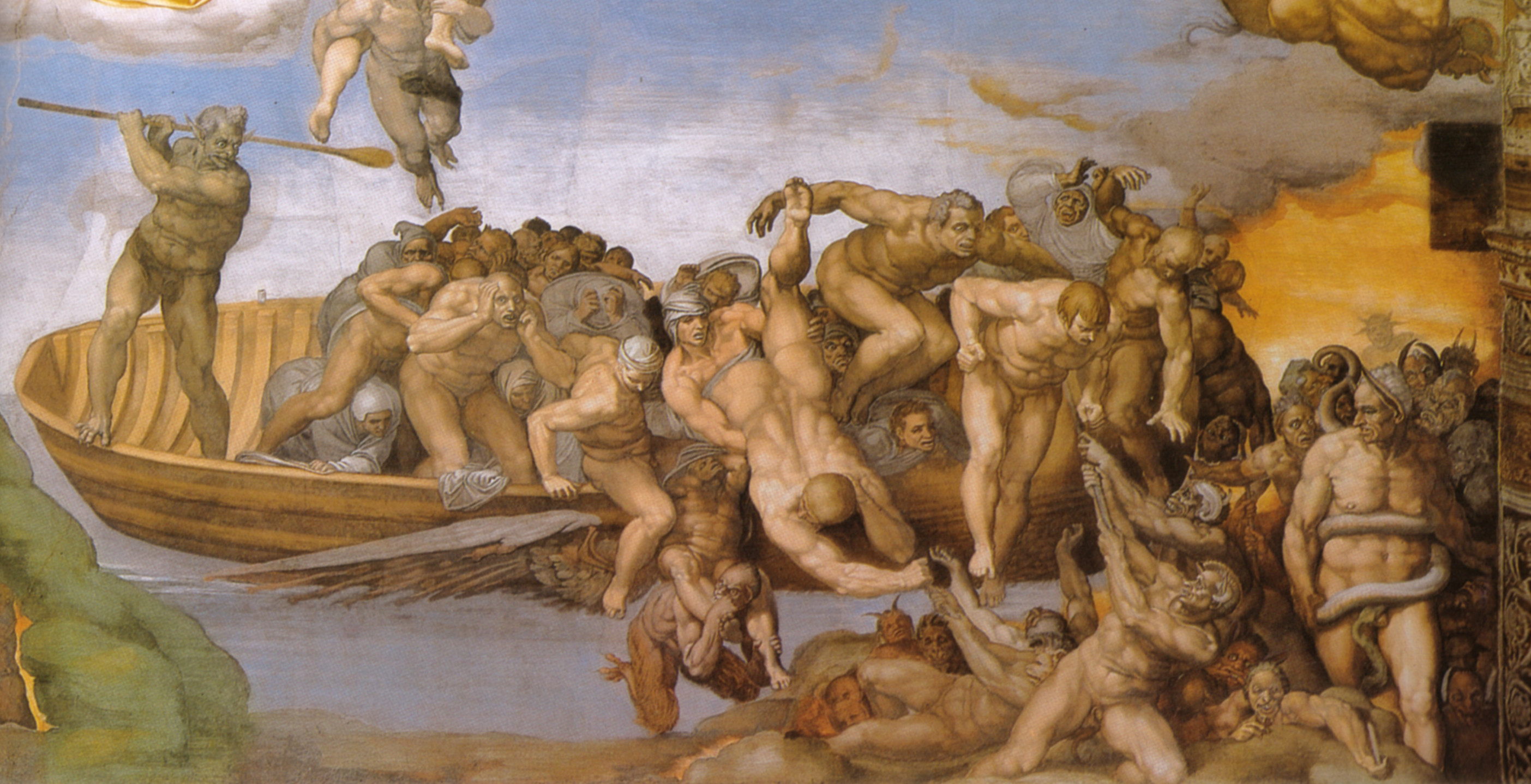
detail from Michelangelo's The Last Judgment [Wikipedia Commons]

from Robert Smithson's essay "What Really Spoils Michelangelo's Sculpture" in Robert Smithson: The Collected Writings:

Could it be that Michelangelo is nothing but a spoiled comedian, who spent long tedious hours working out intricate gruesome jokes, that really aren't too amusing? Are the grotesque horns on his Moses some kind of  a limpid jest? In this drowsy domain devoid of mysterious smiles, there is an undertone of listless laughter and torpid humor. A sluggish and immobile sense of time besieges the viewer of this decadent paganism. Not sloth, but the deterioration of sloth is felt, a decayed acedia that proclaims an inner grief through a profound sense of laziness. An idleness so acute that the body turns to lead and bile, an odious perfection that renders a titanic spectacle of waste. A sinking city of muscles submerges the mind in a somnolence so awful that no escape is possible. A Weltanschauung of criscrossing flesh forces the mind down into brute matter, every action is sunk in "melancholy." In the "Slough of Despond" the foul rot of nature engulfs the entire system of gods and demons. Never has stagnation been more total. Weariness turns into humorous levels of moribund grandeur. Every creature undergoes incessant punishment, because of the enormous weight of this ironclad universe. Bodies are swollen out of proportion, fattened like hogs, they fall downward toward fetid swamps. Heaven becomes a pigsty, a dirt enclosure completely airless, flooded with bilge water — with skies of dusty tar. Muscles like enormous worms, and polypi fade under a sickly ashen light. A slumbrous mood thick with idleness and despair faults every beautiful monster. Before us a psychic state of sterile power unfolds, grave, persistent in its gloom. The slacken bodies seem to stumble over each other, like titanic puppets. It has been said that acedia is caused by an imbalance of humors, Michelangelo seems to prove that speculation. The infirmity of his melancholia seems infinite and unending. Sloth is exalted into a major humor, and its permutations cover a cosmic scale. The stars are replaced with twisted mountains of flesh, there even evil is corrupted. It all looks so disgusting . . . so contemptible — a tidal wave of infinite carnality, a fleshy mess pouring from heaven (which is no place). Wan hope is triumphant in this quagmire of confounded passion. The Saturnine time of neoplatonic order infects his prisoners with an otium corporis that corrodes all spiritual joy and fortitude. Out of this comes the dismal comedy of enervation, a devastated sense of humor, a ruined joke, mock sacrifice, an obliteration of doom. Only nature is left with its maggots and filth — a snake chewing a penis. But this is not sad, it is hilarious. The fatality of humor begins in languor and ends in a farce.


Robert Smithson


Monday, December 30, 2013

30 December 2013


Where Is

the hurt-wingéd gull
here, this one
we search for

the hurt-wingéd gull
another
in worse shape

the hurt-wingéd gull
watch, chaos
circling, turning back

gull against the wall
no fear left
wing-splayed fall

gull against the wall
we return
here, face to face

could we catch
a dog catch
gull against the wall

not dead
eaten or starved
the hurt-wingéd gull

if gull were owl
were hawk, were whole
where is

gull against wall
white rock
hurt-wingéd gull