Thursday, July 24, 2014

John McPhee

John McPhee [Ned Stuckey-French]

from John McPhee's "Cooling the Lava" in The Control of Nature:

Hearing a sound like a chain saw's, I looked down to see a motorcycle climbing the new volcano. The rider wiped out as he approached the crater rim. The motorcycle, pinwheeling, spun downhill in a sputtering swirl of tephra. Ash over teakettle, the rider tumbled, too. At last arresting his fall, he got up, ran after his loose machine, trapped it, then resumed the steep climb. Reaching the top, he zipped around the narrow rim. He stopped for a moment, contemplating. Then he plunged hundreds of feet down the dark-red slope inside the crater all they way to the bottom, under control. Motorcycles seem to have more prestige in Iceland than in, say, Greenwich, Connecticut, or Bryn Mawr, Pennsylvania. All over the new volcano, white-painted automobile tires mark the established tracks and competitive routes of what were described to me as "the largest, most powerful, most beautiful motorcycles in Iceland."

Where the lava went eastward into the sea, some of the new cliffs are a hundred feet high. Waves occasionally break over them. After a Belgian trawler crashed there in 1981, waves threw pieces of the trawler up on top of the cliffs. Rocks weighing half a ton have been tossed up there, too. It was at the base of one such cliff that Gudlaugur Fridthorsson first landed on the night of his long swim. In two places, bays with rocks beaches have indented this new coastline. One is called Baetur the Beach of the Insurance Claim. The other is Vidlagafjara the Beach of the Catastrophe Fund. The rocks, whether they are the size of potatoes, grapefruit, watermelons, water beds, or motor buses, are all rounded. Most are so cavitated by former gas bubbles that they suggest black coral, or models of the human brain. It was discovered on Surtsey and confirmed on Heimaey that such boulders do not require thousands of years to assume their shape but can be rounded by a single storm. During the eruption, a lighthouse on the eastern shore went below the lava. A new lighthouse stands above the Beach of the Insurance Claim.

Tuesday, July 22, 2014

Carla Harryman

Carla Harryman [The Volta]

from Carla Harryman's Adorno's Noise:

It Is Difficult to Write Satire

Lesson

The president was on top of me it's not what you think he was trying to hurt me he didn't know that I had a vest on too that he would have to try harder to get through he was pounding I was scared but unreasonably and so my giggling mingled with fear incredulity and true amusement the president wow was trying to pow me this made him madder he was plowing in with a low ball cut across the chest I'm teaching you a lesson his jaw was relaxing that bewildered set in stone look of determination he used for cameras relaxing a new expression was eeking through showing another self more free less fake by a long shot glowing but bitter "you'll never win you'll never beat me I'm stronger than you" this was obvious whenever he let go his grip on my shoulder even slightly I'd try to slide away from him he wanted to see me cry he pinned me, whispered this in my ear, not knock me out "the smug smile I'm gonna wipe it off your face" that's what he was going for and for me to declare with sincerity I give up you are going to be on top forever I've learned my lesson just move off and I promise you'll never need your fists again when you have completed your term I'll work in your library file your papers escort researchers to the drawers where your secret documents will be kept several decades hence and in the meantime we can keep your wife's favorite poetry books in them along with all the kind notes full of gratitude people have sent you and the personal notes from leaders thanking you for your hospitality and supporting your views on everything from — well you know — staying the course we'll keep the notes in those files until the keepers of state secrets let your truths slip out of their vaults into your drawers full of dignity and proper views and victory I'll call you whenever you like on a special line and report on the most recent display of fan letters one floor down in the presidential museum grand gallery — those tomes you had missed out on reading when you were busy doing your duty being obedient to the higher powers who had bestowed upon you the protective armor we now both share.

Saturday, July 19, 2014

Cherry Pickman

Cherry Pickman [Marina Kaganova]

Cherry Pickman from Jai-Alai Magazine:

Bathymetry

I

If this were a movie and it is
the day would be       protracted but the season
short       after so many miles one tends to forget
tomorrow was never       promised I jumped
              from a boat and stopped       breathing
mostly there is no one else there     there is
              blue of prohibitive depth
there is a hull like home    that is
              rocking        not shaking
there is      a light the camera can't catch

II

If this were a story       I would be held
              accountable        I would string sense
from distinct beginnings        we do nothing
but grow old      watching a horse sleep
is like watching the ocean      the world
              exists more below you than above       waves
are anchored      to a set if you are not
              fettered by fear you are not home

III

If I were a poet I wouldn't be
              so beautiful I could stand outside
myself       for only a short time
           like holding one's breath
the more fear       the more love
the deep wood in the trees reaches
           simultaneously in opposite
directions        I am by no means the first person
condemned        to freedom the wave's
              velocity is predetermined it dragged its blue
from the middle of somewhere

Saturday, July 5, 2014

Paul Blackburn

Paul Blackburn [jacket 12]

from Paul Blackburn's Selected Poems:

Hot Afternoons Have Been in West 15th Street

Here, in late spring, the summer is on us already
                                                Clouds and sun,
                a haze over the city.        Outside my
window the ailanthus nods sleepily under
                                                a hot wind, under
                wetness in the air, the brightness
of day even with overcast.        The chair on the next roof
                sits by itself and waits
for someone to come stretch his length in it.        Suddenly

thunder cracks to the south over the ocean, one can
                                                shuteye see
the waves' grey wife, the storm, implacably stride
rain nipplings on the surface of the sea, the waves
                powerfully starting to rise, raise their
                                                powers before the hot wind
The endless stretchout to Europe disappears, the
rainsweep moving toward the city rising caught in the haze-hot
                                                island atmosphere
                Hate anger powers whip toward the towers rising
from the hum of slugbedded traffic clogging avenues, the trees
                of heaven gracing their backyards crazily
                waving under the strengthening wind

                                                sun brighter
                                                more thunder
                                                birdsong
                                                rises shrilly announcing
the storm in advance in encroach in abstruse syllables of pure
                SOUND    .    SONG    .    SOMEONE
comes to the porched roof to cover the chair from the thunderfilled
                wet atmosphere,        there is
nothing clearly defined wrong I can see except
I must go uptown and see what other storms there
                                be, there

And paint the inside of my wife's white filing cabinet red
that all things may be resolved        correct        and dead    .

Friday, July 4, 2014

Iceland

Lupinus nootkatensis, Alaskan lupine

the ornamental word
the figure, the accessory form
or colour or reference
is rarely content to die to thought
precisely at the right moment
but will inevitably linger
stirring a long brain-wave behind it
of quite alien associations
                                          — Walter Pater

I spun the mildewed pillow to the least gruesome corner, slept there

the meditative poet, sheltering self
from the agitations of the outward world
is in reality only clearing the scene
for the great exhibitions of emotion
                                                       — Ibid.

miles of lupine in lava
of dandelion
damp rock draped with pale brown moss
green moss
runners of cream flower
tufts of easter pink
rock sculpture
more cairns than a traveler needs
an Arctic Kona

Taraxacum offinale, dandelion

The more you see the country
the more you do not wonder why they shut the door.
                                                                               — Gertrude Stein

windows by Mondrian
quadrangled glass in thick, extruded frames
houses white with bright roofs
or houses bright
sheathed in corrugated iron
or concrete mixed with gray sand

I have often noticed how easy it is to have cement around because everywhere there are rocks & so everywhere if you have the necessary building & equipment you have cement. And in the country, it looks strange, it makes it look like dryness or like snow, like Russia or like sand, like a ruin or like a fog, oh dear some people like to live & look at it & some must, or dear, stop when they see it, oh dear.
                               — Ibid.

life is brutish
& short
improvement is illusory
though grand
love is unforeseen
& unattainable
                      & real

fishes engraved on coins

Reykjavik

Sunday, June 8, 2014

William Carlos Williams

William Carlos Williams [New World Encyclopedia]

from William Carlos Williams's Spring and All:

Thus, weary of life, in view of the great consummation which awaits us — tomorrow we rush among our friends congratulating ourselves upon the joy soon to be. Thoughtless of evil we crush out the marrow of those about us with our heavy cars as we go happily from place to place. It seems that there is not time enough in which to speak the full of our exaltation. Only a day is left, one miserable day, before the world comes into its own. Let us hurry! Why bother for this man or that? In the offices of the great newspapers a mad joy reigns as they prepare the final extras. Rushing about, men bump each other into the whirring presses. How funny it seems. All thought of misery has left us. Why should we care? Children laughingly fling themselves under the wheels of the street cars, airplanes crash gaily to the earth. Someone has written a poem.

Oh life, bizarre fowl, what color are your wings? Green, blue, red, yellow, purple, white, brown orange, black grey? In the imagination, flying above the wreck of ten thousand million souls, I see you departing sadly for the land of plants and insects, already far out to sea. (Thank you, I know well what I am plagiarizing) Your great wings flap as you disappear in the distance over the pre-Columbian acres of floating weed.

The new cathedral overlooking the park, looked down from its towers today, with great eyes, and saw by the decorative lake a group of people staring curiously at the corpse of a suicide: Peaceful, dead young man, the money they have put into the stones has been spent to teach men of life's austerity. You died and teach us the same lesson. You seem a cathedral, celebrant of the spring which shivers for me among the long black trees.

Sunday, June 1, 2014

Joan Retallack

Joan Retallack [cacophony]

from Joan Retallack's The Poethical Wager:

Fractal models (with their scalar self-similarities and unpredictable variations) bring into the foreground of our attention the large patterns and erratic details, the dynamic equilibrium of order and disorder in complex life systems like weather and coastlines. This is a geometry of nature that has helped us attend more productively to the chaotic processes of complex turbulent phenomena that static and idealized Euclidean models cannot begin to accommodate. I have begun to think of certain forms of art (for example, the post-1940s music of John Cage) as having a fractal relation to the rest of life. They are complex constructions that, among other things, present their material presence as a dynamically indeterminate "coastline" for audiences to explore via their own complex cultural and psychological dispositions. If one acknowledges language itself as a complex life system, the linguistic tensions and instabilities, semantic ruptures, and self-similar variations in a work like [Gertrude Stein's] Blood [On The Dining Room Floor] invite comparison to fractal forms. Can one in fact view Blood as fractal model of small-town and family turbulence rather than confused detective novel?

The closer you look at fractal models, or the natural phenomena they describe, the more (self-similar) details you see, the more complex things become. (In Euclidean figures the closer you look, the simpler things get.) I wonder whether the kind of "positive feedback loop" that generates fractal self-similarities and variations — data reentering the system again and again, each time undergoing slight modifications — might be an illuminating way to think about Stein's writing process. Might in fact give some intuitions about how the mind (that is, the fractal neural networks of the brain) produces complex linguistic forms based on repetition and variation. We know that in the case of Blood, as with most of her other writing, the product and the process are almost identical. Stein wrote as words came to her and hardly ever made substantial revisions.

And then there's the particular way the form of any coastline structures an exploration of it. The reader can tramp up and down the shifting coastline of Stein's words looking for the lost object (the victim, the culprit) in vain, day after day not finding it, finding instead a strange constancy in the scene of the absent object, the coastline itself as a pattern-bounded indeterminacy in flux. Even if something as reassuring as a body were to turn up with an explanation tagged to its toe, it could hardly become the focal point of this tidal windblown beach or page. Ocean beach and Steinian page are equally contingent and dynamic zones whose life principle is change. The beach changes in its conversation with the vagaries and variabilities of meteorological elements; the page changes in its conversation with variable epistemologies, grammars, and genres, as well as with the associative elements of a reader's mind as that mind lives within multiple intersecting forms whose rules are neither simple nor readily apparent. All this occurs of course within another strange constancy — the changing cultural climate of the developing contemporary. Luckily, coincidentally, both beach and page are locations of aesthetic wonder. Aesthetic wonder is a source of energy even as one hesitates in the face of unforeseen difficulties.

But, you may be quite legitimately asking, this beach stuff — isn't this (metaphorically speaking) building sand castles on an extended conceit? Surely one knows that language is not really a coastline. Well I'm not so sure it's not. Or rather I sense that languages and coastlines operate with similar kinds of principles. If one thinks of a coastline as just one site of mutually transformative exchange between different kinds of complex dynamical systems, then language as it exists in the active mediation between neural network and world ecosystems is surely such a site. There are specific things one gains in thinking of language in this way, particularly when confronted by literature that won't resolve into simple mimesis or tidy containments and conclusions.

It saves a certain amount of frustration to remember that you will never solve a coastline. You can explore, analyze, describe it, visit it as often as you like for the pleasure of it, picnic on it, swim along it, embark from it. It is of course gloriously noncompressible. Its best description can only be conterminous with itself, with its horizons and skies and weather, with the complex, infinite series of possible encounters anyone might have with it. You cannot sum up or paraphrase a coastline, although you can experience topographical limits. Geographers call the point on a landscape where certainty about one's bearings begins to rapidly fall off an "edge." The fractal edges of Stein's art make up part of the active coastline — zone of shifting stabilities and instabilities — between culture and the rest of life — the zone of silence that will never be absorbed in culture but can be wondered at from the vantage points of its edges. Some dimensions of the scalar repetitions and variations within a work of art can be internally formulated, but others have to do with the relation of that work to the history of the language-culture, the history of the art itself (in this case to the novel), to other cultural forms, to forms of everyday life and the natural world.

As location of conventional murder mystery, where all must resolve into a single gory punctum — vanishing point of "the body" — Stein's coastal prose is entirely revelatory in its surprising variations. The more you can't find the object you're looking for, the more you're learning about the language coastline itself.

Tuesday, May 27, 2014

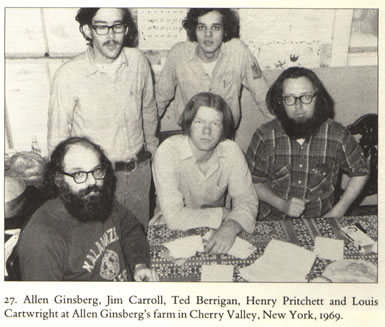
Ted Berrigan

[The Jim Carroll Website]


XXXVIII

Sleep half sleep half silence and with reasons
For you I starred in the movie
Made on the site
Of Benedict Arnold’s triumph, Ticonderoga, and
I shall increase from this
As I am a cowboy and you imaginary
Ripeness begins corrupting every tree
Each strong morning          A man signs a shovel
And so he digs        It hurts          and so
We get our feet wet in air           we love our lineage
Ourselves        Music, salve, pills, kleenex, lunch
And the promise never to truckle         A man
Breaks his arm and so he sleeps      he digs
In sleep half silence and with reason

[do you hear Heaney? who wrote which poem first? did either know the other?]

Monday, May 26, 2014

Jules Laforgue

Jules Laforgue [Caponnetto-Poesiaperta]

David Arkell's ludicrously ill-informed summation of Jules Laforgue's invention of vers libre from Arkell's informative but mediocre Looking for Laforgue: an informal biography:

Laforgue’s vers libre had emerged in a way that was natural, gradual and inevitable. It came directly from his own previous poetry and from nowhere else. So desperate was he to burst out of his formal strait-jacket that certain pages of the Complaintes were already vers libre in all but name (for example, the last fifteen lines of the ‘Complainte des formalités nuptiales’). Then again there are highly wrought passages of prose in the Moralités which, given a nudge, also break up into vers libre (as we have seen in parts of ‘Hamlet’). But vers libre, as evolved by Laforgue, was something quite personal. It was to be followed very closely — in a spirit of homage — by T. S. Eliot. But none of Laforgue’s contemporaries produced anything comparable. The two so-called vers libre poems by Rimbaud are irrelevant here, as is the entire output of Whitman, not to mention the Kahns and Krysinskas. Neither Whitman nor Rimbaud used rhyme in their free verse, whereas with Laforgue it remains an important element. The essence of Laforgue’s vers libre is that it does not abandon the best of traditional poetry. With great skill it preserves all that is worth saving. Without ever rejecting exact rhymes, he adds the subtleties of internal rhymes and half-rhymes. He never spurns an old quatrain or couplet or rolling alexandrine if it can do something for the poem. Above all he includes wit and keeps out rhetoric. It was a form of vers libre that even Eliot in the end unfortunately rejected, though ‘The Love Song of J. Alfred Prufrock’ and ‘Portrait of a Lady’ were in a sense its apotheosis in English.

Thursday, May 22, 2014

Charles Tomlinson

Charles Tomlinson [PennSound]


Canal

Swans. I watch them
come unsteadying
the dusty, green
and curving arm
of water. Sinuously
both the live
bird and the bird
the water bends
into a white and wandering
reflection of itself,
go by in grace
a world of objects.
Symmetrically punched
now empty rivet-
holes betray
a sleeper fence:
below its raggedness
the waters darken
and above it rear
the saw-toothed houses
which the swinging
of the water makes
scarcely less regular
in repetition. Swans
are backed by these, as
these are by
a sky of silhouettes,
all black and almost
all, indefinite.
A whitish smoke
in drifting diagonals
accents, divides
the predominance of street
and chimney lines,
where all is either
mathematically supine
or vertical, except
the pyramids of slag.
And, there, unseen
among such angularities —
a church, a black
freestanding witness
that a space of graves
invisibly is also
there. Only
its clock identifies
the tower between
the accompaniment of stacks
where everything
repeats itself —
the slag, the streets
and water that repeats
them all again
and spreads them rippling
out beneath
the eye of the discriminating
swans that seek
for something else
and the blank brink
concludes them without conclusion.


The Fox Gallery

A long house —
the fox gallery you called
its upper storey, because
you could look down to see
(and did) the way a fox would
cross the field beyond
and you could follow out, window
to window, the fox's way
the whole length of the meadow
parallel with the restraining line
of wall and pane, or as far
as that could follow the sense of all
those windings. Do you remember
the morning I woke you with the cry
Fox fox and the animal
came on — not from side
to side, but straight
at the house and we craned
to see more and more, the most
we could of it and then
watched it sheer off deterred
by habitation, and saw
how utterly the two worlds were
disparate, as that perfect
ideogram for agility
and liquefaction flowed
away from us rhythmical
and flickering and
that flare was final.

Sunday, May 18, 2014

Blaise Cendrars

Blaise Cendrars [Ike]


It was only gradually, and after a long experience of driving, little by little as cars were perfected and roads improved, and one could at last travel at speed, pure speed, that I realized I was insensibly stripping myself bare of everything by forging ahead into the unknown, for to what can one compare speed if not to the slow thrust of thought, which progresses on a metaphysical plane, penetrating, isolating, analysing, dissecting everything, reducing the world to a little pile of aerodynamized ashes (the corners worn away by the wind of the mind!) and magically reconstructing the universe by a fulgurating formula which claps between inverted commas (or the two points between which a record is broken) this illumination which restores life: ‘All the world’s my stage’. . . .

here I only want to pencil in the portrait of Manolo Secca. He is a saint. On my way down, I only passed by, stopping long enough to fill up at the pump; on the return journey, I stayed with him for a week, up to my neck in a barrel of paraffin to get rid of the vermin: lice, jiggers, eggs and larvae that cling to you when you come out of the bush, the hinterland, the swamps and the oceans of grass, and make your skin itch; then I filled up the tank and set off again. . . .

Manolo Secca is taciturn and gives nothing away. All day long, throughout the years and years and years that he has been there, at the frontier of the imaginable world, a desert-like zone that took me two weeks to cross by car, he carves statues out of sections of tree-trunk, which he cuts down himself, black statues and white statues, according to the wood he has chosen, cajù and Brazilian rosewood, life-size figures in small cars, so small that each personage has his own car. He works in a dozen studios at once, spreading out in a circle around the petrol pump, and, when I was staying with him, I counted exactly three hundred and eight figures, some of them finished and others barely outlined or rough-hewn. . . . The curious thing was that all these ridiculous little cars were saloons and the figures were standing on the roofs. Manolo Secca was so amazed by my open car, a grand tourisme tourer, that he took the measurements, promising to carve my statue standing in my life-size car and to place it in front of the petrol pump. ‘You have opened my eyes,’ he mumbled.

Thursday, May 15, 2014

Ki no Tsurayuki

Ki no Tsurayuki [Wikipedia]

tanka from Ki no Tsurayuki's The Tosa Diary, A.D. 935, tr. William N. Porter, 1912:

Though upon the shore
Wind-blown waves break into foam
White like flowers in bloom,
Neither nightingales nor spring
Knew these flowers were blossoming.

While I watch the shore
From the swiftly moving ship,
Do the pine trees guess,
That the hills on which they grow
Seem to move along also?

Fast my teardrops fall,
But to twist a silken thread
Surely would be vain;
Who could thread up pearls so frail?
All my skill wound not avail.

Suminoye’s pines,
As I watch them, seem to be
Younger far than I;
I shall vanish from the scene,
But the pines are evergreen.

If the cherry trees
Nevermore burst forth in bloom,
Twould be better far;
For the saddest time of all
Is the spring, when petals fall.

Saturday, May 10, 2014

Amy Catanzano

Amy Catanzano [YouTube]

from Amy Catanzano's iEpiphany:

replicators.

Like flowers taking flight, migration
is always a maiden voyage.

I equip myself with a bionic device for dreaming
through great distances.

You speak in filigree biology.

Tracking the sun across the sky, other things
trade wings, lift off.


timecapsules.

what do you call us now that we are flying?

how should we hope to find our way?

what are our ideal conditions for flight?

what about the stem-cell of the document?

can you move closer into view?

how do you carry your ideas home?

what is the purpose of global positioning?

do you ever construct veils in flight?

what is the best way to travel through a wake?

how do you approach magical ships?

how do you distinguish ships from the sea?

when do you swap your wings to swim?

how do you respond to coral reefs?

when do you climb up toward the sky?

what can you see from the satellite?

at what point do you run out of air?

do you consider re-entry a political act?

where do you head first after getting back?

what do you distribute as you fly?

are you making a permanent move?

how do you display your souvenirs?

what do you exchange for speeds of light?

Wednesday, May 7, 2014

e e cummings

e e cummings [We Too Were Children, Mr. Barrie]


Chansons Innocentes [excerpt]

I

in Just-
spring          when the world is mud-
luscious the little
lame balloonman

whistles          far          and wee

and eddieandbill come
running from marbles and
piracies and it’s
spring

when the world is puddle-wonderful

the queer
old balloonman whistles
far          and          wee
and bettyandisbel come dancing

from hop-scotch and jump-rope and

it’s
spring
and
       the

             goat-footed

balloonMan          whistles
far
and
wee